Spiritual Journaling for Growth: A 30-Day Path to Your Inner Landscape
September 4, 2026 · 18 min read

What if the ink on your page wasn't just a record of your day, but a map back to your own soul? Perhaps you've tried to write before, only to find it feels like a chore or a messy brain dump. You want to feel connected. You want to feel seen. Embracing spiritual journaling for growth isn't about filling pages with perfect prose. It's about creating a quiet space for your spirit to breathe. It's a gentle return to your center.
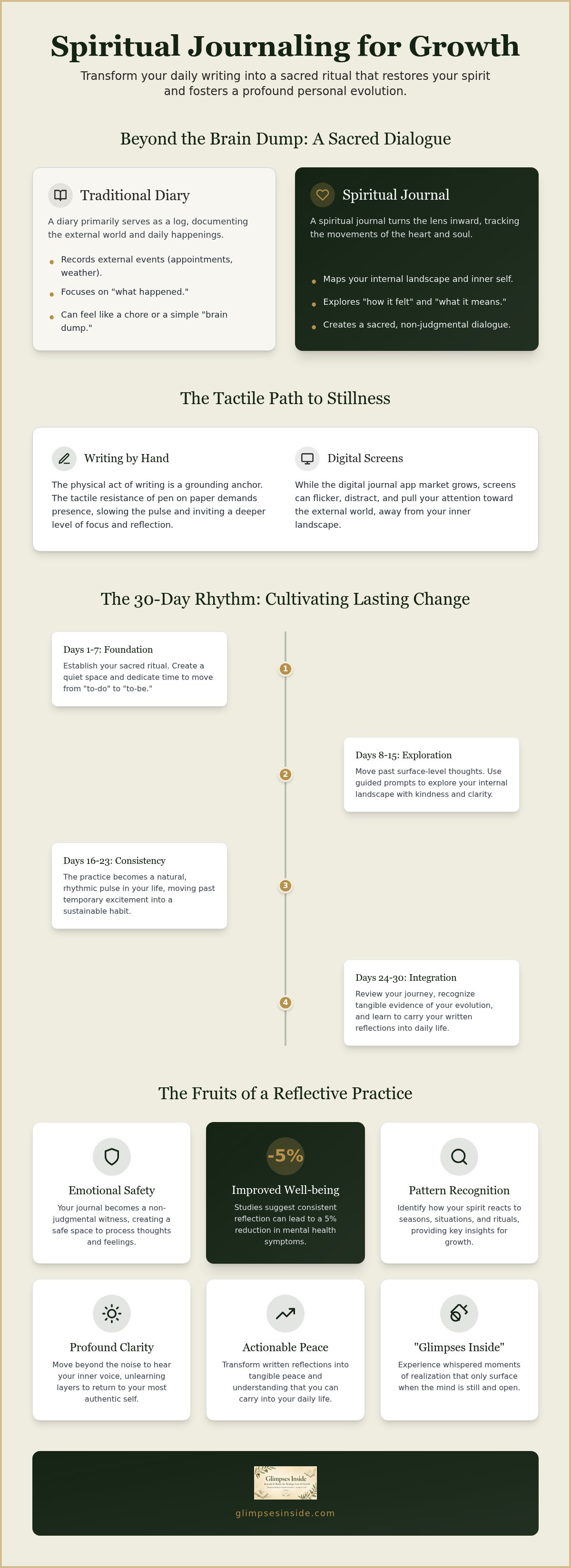
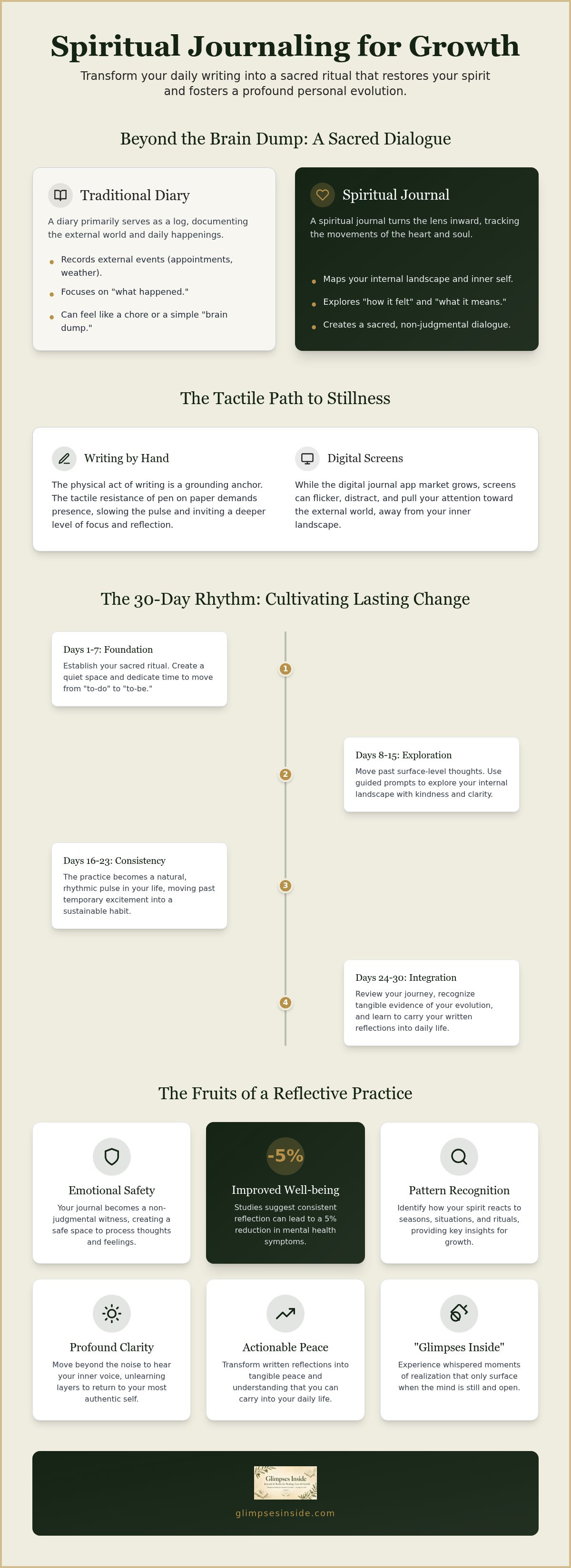
I understand the struggle of staying consistent when your practice feels like just another item on a heavy to-do list. You deserve a ritual that nourishes you. Studies suggest that consistent reflection can lead to a 5% reduction in mental health symptoms, providing a steady foundation for your heart. This article promises to transform your daily writing into a sacred ritual that restores your spirit and fosters a profound personal evolution. We'll explore how a structured Just 30 Days approach provides the framework you need to thrive. Together, we'll walk through a path designed to cultivate inner peace and clarity. Let's begin this journey into your inner landscape, one soft word at a time.
Key Takeaways
- Move beyond the brain dump to establish a sacred dialogue with your inner self. Learn the difference between a simple diary and a reflective, soul-centered practice.
- Reclaim your focus through the tactile experience of writing by hand. Discover how the weight of paper and the flow of ink ground your spirit in the present moment.
- Navigate the 30-day rhythm to move past temporary excitement into lasting change. This timeframe allows spiritual journaling for growth to become a natural, rhythmic pulse in your life.
- Utilize guided prompts to explore emotional safety and personal boundaries. These targeted questions help you map your internal landscape with kindness and clarity.
- Transform your written reflections into actionable peace for your daily life. Learn to review your journey and recognize the tangible evidence of your personal evolution.
The Essence of Spiritual Journaling: More Than Just Words
Spiritual journaling for growth is more than a simple record of your daily events. It's a sacred dialogue. A quiet, intentional conversation between your pen and your soul. In a world that demands constant noise and rapid response, this practice offers a sanctuary of stillness. It's not about performance or perfect grammar. It's about presence. It's an invitation to sit with yourself without judgment.
While the practice of keeping a diary has historically served as a way to document the external world, a reflective spiritual practice turns the lens inward. A traditional diary might track your appointments or the weather. A spiritual journal tracks the movement of your heart. In this context, growth doesn't mean becoming someone new. It means returning to your most authentic self. It's a process of unlearning the layers that hide your true spirit. Journaling acts as a gentle anchor. When the world feels chaotic, the page remains steady.
Connecting with Your Inner Landscape
When you sit in quiet reflection, you begin to experience "glimpses inside" your own spirit. These are small, whispered moments of realization that only surface when the mind is still. You move past surface-level thoughts about your to-do list. You reach for heart-centered truths instead. This shift requires a soft kind of vulnerability. It's an act of courage to be honest on the page. Yet, this very openness is what fosters your spiritual evolution. You stop performing for the world. You start listening to your own rhythm.
The Benefits of a Reflective Practice
Documentation creates a sense of emotional safety. Your journal becomes a non-judgmental witness to your private journey. By building a steady rhythm of hope through daily writing, you create a foundation for restoration. Small actions lead to big shifts. Over time, you'll start to identify patterns in your spiritual journey. You might notice how your spirit reacts to certain seasons or how your peace returns after specific rituals. These insights are the milestones of your evolution. They prove that you're moving forward, even on the days when you feel still.
A structured approach, like the Just 30 Days framework, helps maintain this consistency. It provides the gentle guardrails needed to keep your practice from feeling like a chore. You aren't just dumping thoughts onto paper; you're cultivating a garden. Each entry is a seed. Each moment of reflection is water. With patience and presence, your inner landscape begins to bloom into a place of profound clarity and peace.
Crafting Your Sacred Ritual: The Tactile Path to Stillness
Ritual is the bridge between the noise of the world and the stillness of your soul. When you engage in spiritual journaling for growth, the physical act of writing becomes a grounding anchor. A digital screen flickers. It distracts. It pulls you toward the external. In contrast, the tactile resistance of pen on paper demands presence. You feel the grain. You see the ink flow. This sensory engagement slows the pulse and invites a deeper level of focus.
Create a quiet corner for your daily restoration. This isn't just a physical space; it's a mental sanctuary. Setting the intention to move from "to-do" to "to-be" is essential. You aren't checking a box on a list. You are tending to a spirit that needs to be heard. By dedicating a specific time and place, you signal to yourself that your internal evolution is a priority. It is a commitment to your own restoration.
Choosing Your Tools for Reflection
While the global digital journal app market is projected to reach $6.34 billion in 2026, there is a profound difference between a tap and a stroke. Physical journals anchor self-reflection in a way that pixels cannot. They become supportive companions. They hold the weight of your words and the history of your shifts. Selecting a journal that feels right in your hands is the first step toward building a sustainable habit. Curated gift boxes can help set this soulful mood from the very first moment, turning the act of starting into a celebrated event of self-care.
Designing a Sensory Experience
Your environment speaks to your subconscious. Soft lighting, a familiar scent, or the texture of a linen cover can signal to your heart that it is safe to open. Medical research highlights the value of Journaling for Emotional Wellness, noting its ability to help manage stress and anxiety. This clinical benefit is amplified when you involve your senses. The tactile engagement of the healing process allows you to stay grounded in the present moment, making the practice feel less like a chore and more like a gift.
If you feel resistance, don't force long sentences. Use short, staccato fragments of thought. Let the ideas breathe. These brief bursts break through the mental noise and allow heart-centered truths to surface. Consider exploring the Just 30 Days series to find a structured, sensory-focused framework for your personal restoration.
The 30-Day Rhythm: Why Gentle Consistency Cultivates Growth
Thirty days is a heartbeat. It's the time it takes for a habit to take root and for the spirit to begin its quiet unfolding. When we commit to spiritual journaling for growth, we aren't looking for a lightning bolt of change. We are looking for the steady, soft light of a rising sun. High-energy bursts of effort often fade into exhaustion. Gentle consistency, however, builds a bridge to the soul that lasts. It's a rhythmic ritual of returning to your center.
Recent research on the benefits of spiritual journaling highlights how this practice supports both psychological well-being and spiritual maturation. It isn't just about writing. It's about the rhythm of returning to yourself day after day. This month-long window allows you to move past the initial "honeymoon phase" where everything feels new and into the deeper, more transformative work of honest reflection. A month of discovery creates a lasting spiritual habit that sustains you long after the pages are full.
Navigating the 30-Day Journey
The first ten days are about breaking the surface. You find your voice. You learn to trust the pen. It's a time of discovery and perhaps a little discomfort as you settle into the silence. You are clearing the path, moving past the surface-level noise of your to-do list to find the whispers underneath.
The middle ten days often feel like a "messy middle." The novelty has worn off. This is where deeper truths begin to surface. You might encounter shadows, old patterns, or a sense of resistance. Stay with them. This is where the evolution happens. By continuing to show up, you tell your spirit that its truths are worth the effort of documentation.
The final ten days are for integration. You start to see the threads connecting your entries. Clarity is born not from a single entry, but from the cumulative weight of your presence. You are no longer just writing; you are witnessing your own evolution. The birth of new clarity arrives as a soft whisper, confirming that you've returned to your most authentic self.
Finding Stillness in the Noise
Some days, the world is too loud. The words won't come. Your hand feels heavy. On these days, "gentle consistency" is more important than "perfect output." Even a single sentence or a few staccato fragments are enough to maintain the connection. It's about showing up for yourself, even when you have nothing "profound" to say.
Using a structured tool, like a 30 day journal for clarity, can help you stay focused when your mind wanders. It acts as a compass. It reminds you that the goal isn't to be a "good writer." The goal is to be a present witness to your own life. This practice isn't a rigid discipline. It's a soft place to land. It ensures that even in the noise, your inner landscape remains a place of peace and restoration.
Guided Prompts for Soulful Discovery and Inner Clarity
A question is a key. It opens doors that have been locked by the rush of daily life. In your journey of spiritual journaling for growth, prompts act as gentle guides. They lead you away from the surface noise. They invite you into the quiet rooms of your heart. Without a prompt, the blank page can feel cold or demanding. With a prompt, the page becomes a warm invitation. It's a conversation starter between you and your most authentic self.
Start with the breath and the body. Grounding is the foundation of any spiritual work. Ask yourself, "What does my spirit feel like in this exact second?" or "What three textures am I grateful for right now?" These simple inquiries anchor you in the physical world. They prepare you to dive deeper into the nuances of your spirit. They remind you that you are here, present and safe.
Prompts for Emotional Restoration
Sometimes the heart is weary. It needs a soft place to land. Use these questions to invite a supportive whisper into your day. There are no wrong answers. There is only the truth of your current state. Be patient with yourself as the words emerge.
- "What part of my heart is asking for a supportive whisper today?"
- "Where in my life am I seeking a gentle restoration?"
- "What small, consistent action would lead to a profound shift?"
These reflections aren't meant to be solved. They're meant to be felt. By documenting these needs, you acknowledge your own worth. You begin the process of internal healing through the simple act of being honest with yourself.
Deepening Self-Awareness
Exploring your inner landscape requires specific imagery. When you visualize your internal world, you make the abstract tangible. You turn feelings into landmarks you can navigate with kindness. This visualization helps you move from surface thoughts to heart-centered truths.
- "If my spirit had a voice today, what would it be whispering?"
- "What glimpses inside have I ignored lately?"
- "What boundaries would make my heart feel safer tonight?"
Growth is a passage of time. It's a slow unfolding. Ask yourself, "Who is the woman I am becoming in these thirty days?" or "What would my future self thank me for today?" These reflections bridge the gap between who you were and who you are being called to be. They foster a sense of hope. They remind you that evolution isn't a race. It's a return to peace. If you're looking for a companion on this path, explore the Just 30 Days series to find the perfect framework for your daily restoration.
Integrating Growth: From the Page to Your Daily Life
The 30 days are nearly complete. Now comes the most delicate part of the journey. You must carry the stillness you found on the page into the vibrant noise of the world. Integration is the final step. It's the moment your written insights become lived experiences. By reviewing your entries, you start to see the threads of your personal evolution. You notice how your reactions have softened. You see how your peace has deepened. This is the fruit of spiritual journaling for growth.
Intentionality is your compass here. It's not enough to simply close the book and walk away. You must choose to carry that inner clarity into your conversations, your work, and your rest. This practice becomes a sturdy foundation for mindful living. You are no longer just reacting to life. You are responding from a place of centered truth. You are moving with a soft confidence that feels like a supportive whisper to your own soul.
Living Your Reflections
Your journaled intentions are seeds. They require daily, gentle actions to grow. If you wrote about a need for boundaries, today is the day you honor one. If you discovered a thirst for quiet, you carve out five minutes of silence before lunch. This is how you bridge the gap between the quiet of the page and the rush of reality. This is the true power of spiritual journaling for growth; it transforms your internal landscape into a guide for your external world. These small, consistent shifts lead to profound internal changes.
Sharing your growth can also deepen emotional intimacy with those you love. When you are more connected to your own spirit, you can connect more authentically with others. Vulnerability on the page prepares you for vulnerability in your relationships. Your journey doesn't end at day thirty. It simply shifts into a new, more expansive phase of connection and understanding.
The Gift of Continued Presence
Continuing this practice is a profound form of self-love. It is a way of telling your spirit that its voice still matters. You might choose to start another Just 30 Days cycle or explore upcoming books by Ianthe Writes for fresh inspiration. These new paths offer continued support as you navigate the nuances of your internal landscape. Your restoration is not a destination. It is a rhythmic pulse. It is a steady return to the heart.
Be patient with yourself as you move forward. Some days will feel effortless. Others will feel like a climb. Remember that your evolution is a beautiful, unfolding process. It cannot be rushed. It can only be witnessed. Trust the work you have done. Trust the clarity you have found. You are returning to your most authentic self, one word at a time.
Your Unfolding Journey Toward Peace
The path back to yourself is a slow, sacred unfolding. You've discovered that spiritual journaling for growth is far more than a simple record of events. It's a rhythmic ritual of returning to your center. By choosing the tactile weight of paper and embracing a gentle 30-day cycle, you've built a sanctuary of stillness within a chaotic world. These entries aren't just ink on a page. They are a map of your personal restoration and a witness to your soul's quiet evolution.
Ianthe Writes provides intimate, author-led publications designed to guide you through these internal shifts with warmth and intentionality. To further enhance your reflective ritual, our curated gift boxes offer a sensory experience that honors your commitment to self-discovery. You deserve a space where your spirit can breathe and expand. Explore the Just 30 Days series to begin your gentle journey of restoration today. Your evolution is a beautiful, unhurried process. Trust the steady pace of your own heart as you continue to bloom.
Frequently Asked Questions
What is the best time of day for spiritual journaling for growth?
The best time is whenever you can find a quiet, uninterrupted pocket of stillness. Many find the soft light of morning ideal for setting an intention before the world's noise begins. Others prefer the reflective hush of the evening to process the day's movement. Consistency matters more than the specific hour. Choose a window that feels like a supportive whisper rather than a rushed chore on your to-do list.
How long should a spiritual journaling session last?
A session typically lasts between ten and twenty minutes. This timeframe is enough to move past surface-level thoughts without feeling overwhelmed. You don't need hours to cultivate spiritual journaling for growth. Even a brief, focused ritual of five minutes can offer profound clarity if you are fully present. Let the rhythm of your own heart dictate the length. Some days require more space; others need only a few staccato fragments of thought.
Can I do spiritual journaling digitally, or is paper better?
Paper is often better for grounding the spirit and fostering deep presence. The physical act of writing by hand creates a tactile connection that digital apps cannot replicate. While the digital market is growing, the weight of a physical journal and the flow of ink offer a sensory experience that anchors you in the moment. Physical tools from the Just 30 Days series are designed specifically to support this grounded, intimate reflection.
What if I don’t feel "spiritual" when I start writing?
You don't need to feel "spiritual" to begin; you only need to be honest. Spirituality often hides in the mundane details of our lives. Start by documenting what you see, hear, or feel in your body. This grounding act clears the path for heart-centered truths to surface later. Presence is the only requirement. Growth is a slow unfolding that begins with the simple courage to show up exactly as you are.
How do I handle negative emotions that come up during journaling?
Treat negative emotions as gentle guides rather than obstacles. When shadows or heavy feelings arise on the page, sit with them with kindness. Documentation provides a safe container for these truths. You aren't "venting" on paper; you are witnessing your own internal landscape. Acknowledge the discomfort, breathe through it, and allow the ink to hold the weight. This process is essential for personal restoration and emotional safety.
Is 30 days really enough to see spiritual growth?
Thirty days is the optimal window to witness significant internal shifts. It is long enough to move past the initial novelty and into deeper self-awareness. While the soul's journey is ongoing, a month of gentle consistency creates a sustainable habit. You'll begin to see patterns in your spiritual journaling for growth that offer tangible proof of your evolution. It is a powerful first step toward a lifetime of mindful living.
What should I do with my journal after the 30 days are over?
Review your journey to celebrate your personal evolution. Look for recurring themes, whispers of hope, or shifts in your perspective. You might choose to keep the journal as a sacred record or start a new cycle with the Just 30 Days series. Some find that revisiting their words months later offers fresh clarity. Whatever you choose, treat the completed pages as a testament to your commitment to your own heart.
How do I choose the right prompts for my specific situation?
Choose prompts that mirror your current emotional state or the restoration you seek. If you feel scattered, look for grounding inquiries. If you feel disconnected, seek questions that explore your inner landscape. The Just 30 Days series provides a structured path, so you don't have to search for the right words alone. Trust your intuition to lead you toward the questions that your spirit is currently whispering.