How Writing Helps Process Difficult Emotions: A Gentle, Practical Guide
October 8, 2026 · 16 min read

What if you don’t have to understand every feeling before you begin writing? When emotions feel tangled or too big to hold, a few honest words can create space around them. That’s one way how writing helps process difficult emotions: it gives you room to name what’s there without judging it or needing to solve it straight away.
You may worry that writing about something painful could make it feel stronger. That concern makes sense. You can go slowly, choose a gentler starting point, or stop whenever you need to. There’s no right way to fill a page, and writing isn’t a cure-all or a substitute for support when you need more help.
In this guide, you’ll learn why putting feelings into words can bring perspective, what to try when the blank page feels daunting, and how to recognise when it’s time to pause. Use the prompts and practical steps as options, not obligations. You can begin where you are, one small sentence at a time.
Key Takeaways
- Emotional processing can begin by noticing and naming a feeling, without trying to solve it immediately.
- Explore how writing helps process difficult emotions by separating what you feel from the assumptions or immediate reactions around it.
- Writing can feel intense, so pay attention to your limits. You can pause, change direction, or seek support.
- Try a flexible writing sequence focused on what you notice now, rather than forcing yourself to disclose painful details or find a solution.
- Choose free writing, a prompt, or a guided resource such as Just 30 Days. Let the practice fit your needs instead of turning it into an obligation.
How writing helps process difficult emotions: a gentle starting point
A difficult feeling can arrive all at once. You might know you’re upset, but not whether you feel hurt, angry, worried, disappointed, or several things at the same time. Finding a name can take patience. You don’t have to choose the perfect word before you begin, and you don’t have to turn the page into a plan for fixing everything.
Here, emotional processing means noticing, naming, and reflecting on what you feel without demanding an instant solution. Writing can offer a place to do that at your own pace. It isn’t a polished story, a demand to think positively, or professional treatment. It can support reflection, but people’s experiences differ, and no particular outcome is guaranteed.
What does it mean to process an emotion through writing?
Putting an experience into words can make it easier to look at, even if the words are unfinished. You might write, “I feel tense after that conversation,” and pause there. The sentence notices the feeling. It doesn’t judge you for having it, insist that you fix it, or push it away. Writing through a feeling means giving it words and attention without requiring yourself to resolve it.
Expressive writing is one name for writing about thoughts and feelings connected to personal experiences. The label doesn’t mean every entry needs to be revealing or beautifully told. A few plain sentences, a list of fragments, or a note that says “I’m not sure yet” can be enough to begin looking more closely.
Why put difficult feelings on the page?
A page can hold thoughts you may not feel ready to say aloud. For example, after a tense exchange with someone you care about, you might write, “I’m angry, and I’m also worried I’ll be misunderstood.” Seeing both thoughts together may help you notice that the moment contains more than one feeling. Your experience may be different; there’s no single story you need to match.
You can write privately in a notebook or somewhere that feels comfortable to you. Keep the entry brief if you prefer, and stop before exploring details that feel too raw. The aim isn’t to create a complete account of what happened. It’s to make room to notice what’s present, in words that feel honest enough for now.
If a gentle structure would make starting easier, this reflection resource on a 30-day journal for clarity offers a related way to approach writing. A guide is optional. Free writing, a single sentence, or choosing not to write are all valid ways to meet yourself where you are.
What happens when you write about a difficult feeling?
Writing doesn’t make every feeling clear, and it doesn’t have to. Putting a moment into words may help you slow down enough to notice what’s happening inside you. Instead of holding a rush of reactions as one heavy blur, you can begin to separate its parts: what happened, what you felt, and what you’re telling yourself about it.
One way to understand how writing helps process difficult emotions is to see it as creating a small pause between a feeling and your response to it. That pause may offer room for reflection, though it won’t work the same way for everyone or guarantee a particular result.
Naming feelings without judging them
Try ordinary words such as hurt, fear, disappointment, relief, or uncertainty. You don’t need the most precise label. “I feel bad” is a place to begin; you might then wonder whether “hurt” or “worried” feels closer. The point isn’t to get the answer right. It’s to describe what you notice without criticising yourself for feeling it.
Feelings can arrive in pairs. You might feel relieved that a difficult conversation is over and sad about how it went. You might be angry and still care about the person involved. These feelings don’t cancel each other out. Writing them side by side can make room for that complexity without asking you to choose just one.
Finding a little distance and perspective
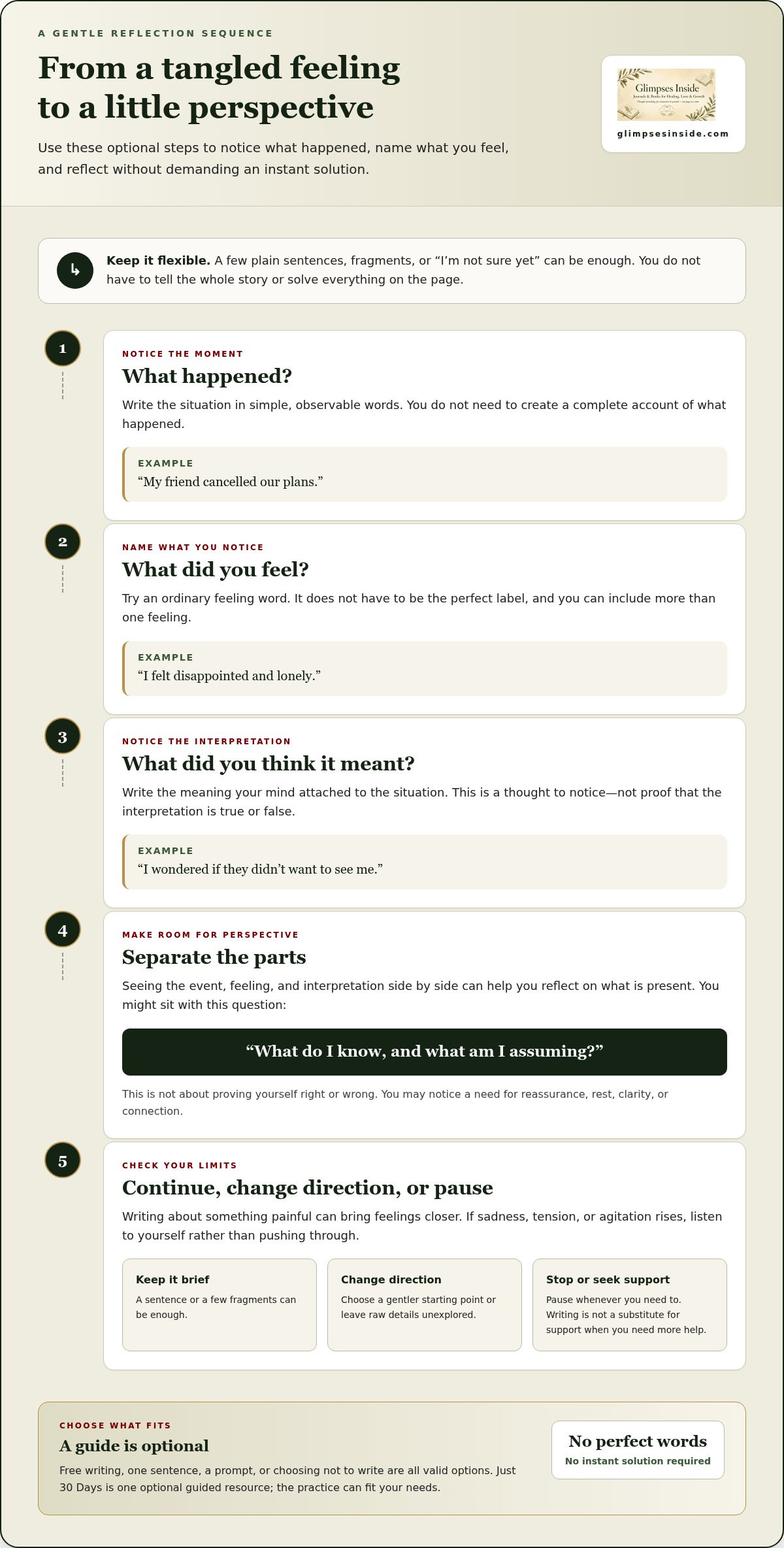
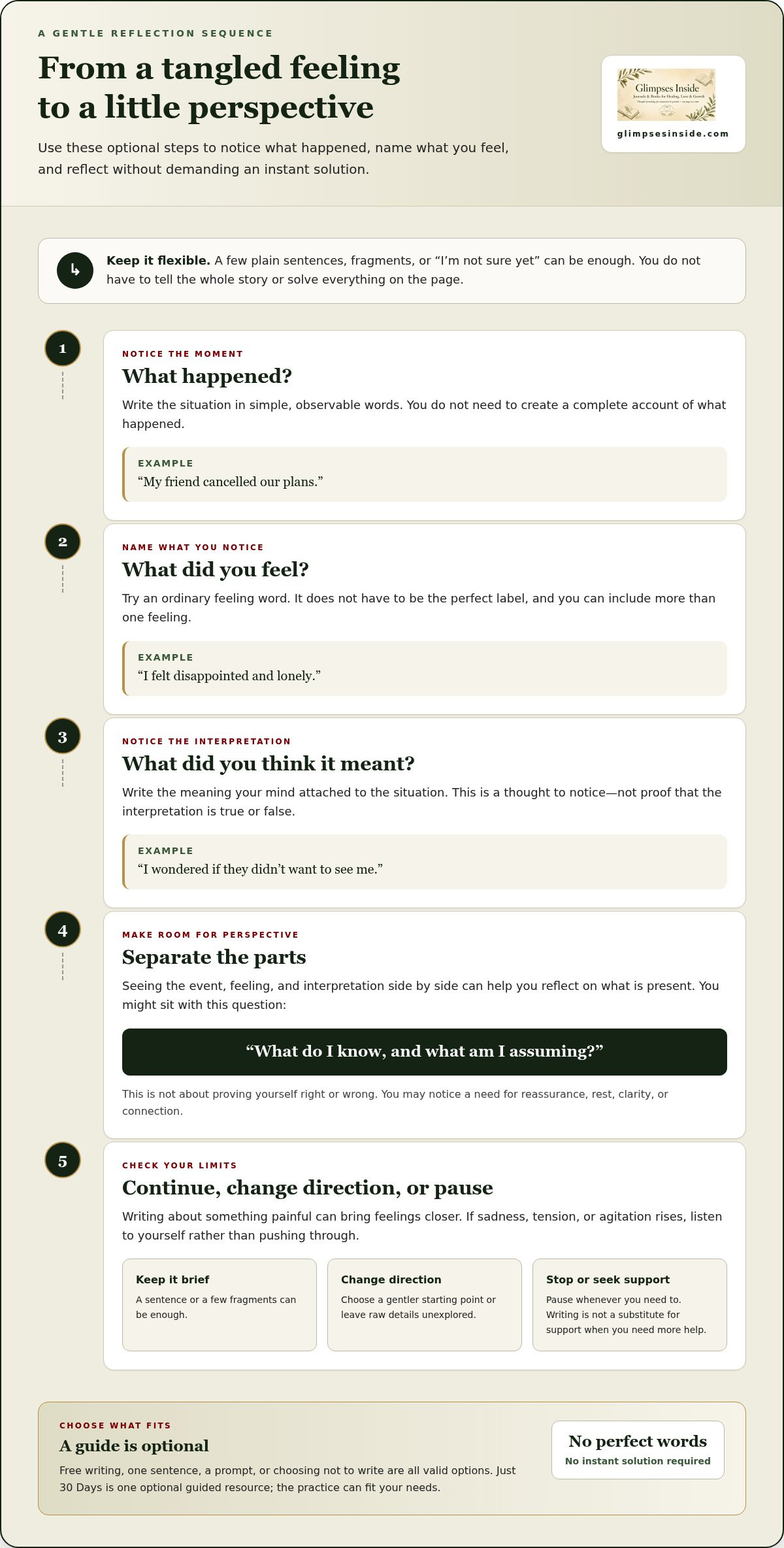
A written sequence may help you notice context: what came before the feeling, what seemed to set it off, and what you needed in that moment. If it feels useful, try separating a situation into three parts:
- What happened: “My friend cancelled our plans.”
- What I felt: “I felt disappointed and lonely.”
- What I thought it meant: “I wondered if they didn’t want to see me.”
This isn’t a way to prove that an interpretation is true or false. It helps distinguish the event from the meaning your mind attached to it, and from the emotions that followed. That distinction may suggest a question worth sitting with: “What do I know, and what am I assuming?” You might also notice recurring thoughts or a need for reassurance, rest, clarity, or connection.
Writing may create reflective distance by letting you look at a feeling in words, rather than only experiencing it as a rush of reactions. This describes one way to use the practice, not a promise that writing will change how you feel. Rereading is optional. You can return to an entry later, leave it untouched, or stop if looking back doesn’t feel helpful.
If a gentle structure would support your reflection, Just 30 Days is an optional guided resource to explore at your own pace. A notebook or a few lines in your phone can serve just as well.
Can writing make difficult emotions feel worse? Understanding the limits
It can. Writing about a painful experience may bring feelings closer before they feel easier to hold. You might notice sadness, tension, or agitation rising as you write. That doesn’t automatically mean you’ve done something wrong, but it is a reason to listen to yourself rather than push through. Asking how writing helps process difficult emotions also means asking when it may be better to pause.
Reflecting on something tender can feel uncomfortable, but you don’t have to decide that distress is productive or keep writing in the hope that it will pass. If you feel increasingly overwhelmed, unable to stay present, or unsettled for a long time afterward, stop the exercise. You’re allowed to close the journal without finishing the thought.
When writing feels emotionally intense
Notice what’s happening as you write. If your distress is rising or you’re finding it hard to connect with the room around you, set the page aside. Look around and name a few things you can see, feel your feet on the floor, or choose another grounding activity that feels comfortable. You don’t need to return to the entry. If the distress persists or feels unmanageable, reach out to someone you trust or a mental-health professional.
Before you begin, make a simple pause plan: decide that you can stop at any point, keep the writing brief, and choose what you might do afterward. That could mean getting a drink of water, stepping outside, or turning your attention to an ordinary task. These are options for shifting your attention back to the present, not ways to force yourself to feel calm.
Pay attention to the pattern over time. If writing repeatedly leaves you feeling more overwhelmed, change the subject, write about something less intense, use a neutral prompt, or choose not to write. A practice that doesn’t feel helpful right now doesn’t need to become an obligation.
What writing can and cannot offer
A page can give you room to reflect, but it can’t resolve every circumstance, relationship, or source of pain. Writing doesn’t promise healing, closure, symptom relief, or a particular timeline. Reflective writing can help you explore your thoughts; professional mental-health support offers care that a journal cannot provide.
If difficult feelings are affecting your ability to manage day-to-day life, or you’re dealing with ongoing distress, consider speaking with a qualified mental-health professional. Writing may sit alongside that care if it feels appropriate, but it shouldn’t replace it. You deserve support that responds to your needs, not pressure to manage everything on your own.
If you may be in immediate danger or might hurt yourself, seek urgent help now through local emergency services or a crisis support service where you are. You don’t have to keep writing first. Pausing is a valid choice, and reaching for another person’s help can be the next gentle step.
How to write about difficult emotions at a manageable pace
A writing practice doesn’t need to be long or complete to be worthwhile. Think of it as a small check-in, not a task you have to finish. You can stop at any point, skip a question, or decide that today isn’t the day to write. The aim is to notice what’s present, not to force a confession or reach a tidy answer.
A gentle sequence for beginning
Choose a moment and place that feel private enough for you. Set a short time boundary, perhaps a few minutes, or decide to write one paragraph. It’s a limit you can adjust, not a daily target or a test of commitment. If the feeling already seems too close or overwhelming, choose a lighter subject or leave the page for another time.
Then move through these prompts in order, adapting or skipping any that don’t feel right:
- Begin with what’s here: “Right now, I notice…” Finish the sentence with a feeling, a sensation, or even “I’m not sure.”
- Name the feeling: Try a simple word such as worried, hurt, relieved, or frustrated. More than one word can fit.
- Describe the moment: Write a few lines about what happened in language that feels natural to you. This isn’t for an audience, so it doesn’t need to sound polished or include every detail.
- Wonder what you need: Ask, “What might this feeling need from me right now?” An answer could be rest, space, a conversation, or “I don’t know yet.” Leave it open if nothing comes.
How to keep the practice supportive
Choose handwriting or typing according to what feels comfortable and accessible. Neither method is required. If the words begin to feel like too much, put the pen down or close the document, even if you’re in the middle of a sentence. An unfinished page isn’t a failure. It may simply mean you’ve reached your limit for now.
Before you finish, pause for a brief check-in: What feels clearer, if anything? What support do I need now? You might find that one part of the experience is easier to name, or that you still need company, rest, or help from someone you trust. There’s no need to find a meaningful conclusion. This check-in can help you return your attention to the present and decide what would feel supportive next.
Close with a simple transition. Stretch your hands, notice the room, or move into an ordinary activity. If a guided structure feels more comfortable than beginning alone, explore Just 30 Days as an optional companion for reflection. A guide can offer a starting point, while the pace and choice to pause remain yours.
Making reflective writing a gentle practice, with or without a guide
Reflective writing doesn’t need to become another thing to keep up with. You can write freely, follow a prompt, return to the page occasionally, or decide not to write at all. A helpful practice leaves room for your needs to change. Consistency can mean making space when it suits you, not keeping a streak or proving you’re committed.
Choosing between free writing and guided reflection
Free writing lets you choose the subject, length, and pace. You might begin with a sentence about something on your mind and follow it wherever it goes, or stop after a few lines. Guided reflection offers more structure for days when choosing a starting point feels difficult. Neither approach is better. You can move between them or use neither, depending on what feels supportive.
If the feelings you’re exploring involve someone close to you, you may find it useful to consider how reflection can sit alongside care for the relationship. This article on deeper emotional intimacy through reflection offers a related perspective. You can reflect on your own feelings without needing to write a message to the other person or decide what the relationship should become.
A small next step that respects your pace
If you’d like to try writing, begin with one sentence today: “The feeling I notice right now is…” You can leave it there. If it feels comfortable, add what was happening when the feeling showed up or what might help you feel supported. There’s no need to write about the most painful thing on your mind. A smaller, less charged subject can be a kinder place to start.
Some people like a loose routine, such as keeping a notebook nearby and writing when a feeling asks for attention. Others prefer to use a prompt now and then. You can skip a day, take a break, or stop altogether. None of those choices means you’ve failed. As you learn how writing helps process difficult emotions, let your experience guide the pace rather than a rule about how often you should write.
Just 30 Days is a reflective publication for readers who would like a guided starting point. It can accompany your own reflection, not promise a particular outcome or require you to write every day. A blank page can be enough, too.
If a structured companion feels right for you, explore Just 30 Days and decide whether it fits the way you’d like to reflect.
Let your next step be small
You don’t have to turn writing into a routine before it can matter. Let it be a place you return to when you want to listen inward, and let it rest when you don’t. Even a single honest line can mark a moment of attention. Over time, you may find your own way of understanding how writing helps process difficult emotions, shaped by what feels comfortable and true for you.
If you’d like structure for your reflections, Just 30 Days is a reflective publication from Glimpses Inside, owned and operated by author Ianthe Writes. It can offer a starting point for your own practice, at a pace that remains yours.
Explore Just 30 Days for a guided starting point for your reflective writing.
Frequently Asked Questions
Can writing really help process difficult emotions?
It may help some people make feelings easier to examine, though it isn’t a guaranteed treatment or a fit for everyone. Research on expressive writing explores how people use words to reflect on personal experiences, but individual responses differ. If you try it, notice whether the practice feels useful, neutral, or uncomfortable for you. You can choose another way to reflect or seek professional support when writing isn’t enough.
What should I write when I feel overwhelmed?
Start with one detail you can name without explaining the whole situation. You might write, “My shoulders feel tense,” or “I’m worried about the call I need to make.” Keep the focus on what’s happening now, rather than trying to capture every cause or consequence. If the words make your distress rise, close the page and turn to a grounding activity or someone you trust.
Can journaling make anxiety or sadness worse?
It can feel intense for some people, particularly if writing draws attention to a painful memory or a worry that feels close. That response can differ from one person or writing session to another. If you notice distress increasing, stop rather than pushing through. If difficult feelings continue or become hard to manage, consider reaching out to a qualified mental-health professional. Journaling isn’t a replacement for care.
How long should I write about a difficult emotion?
There isn’t one ideal length. You could begin with a few lines or set a brief timer, then stop when it rings or sooner if you feel uncomfortable. The timer is simply a boundary, not a requirement to keep writing until it ends. You don’t need to fill a page or reach a breakthrough. Let your comfort, not a target, shape how long you spend.
Is writing about feelings the same as therapy?
No. Writing on your own is a personal reflection activity; therapy is professional care shaped around a person’s needs. A journal can’t assess a mental-health condition, offer a professional treatment plan, or replace care from a qualified professional. Some people may choose to use personal writing alongside other support, if it suits them. If distress feels persistent, severe, or difficult to manage alone, seek professional help.
Should I reread what I wrote about a painful experience?
Only if you want to. Before rereading, ask yourself whether you feel ready to revisit the entry and whether you have space to pause afterward. You might choose to read just a few lines, then check how you feel. If it becomes overwhelming, close the page. You don’t have to keep, share, or return to private writing for it to have served its purpose.