Journals for Emotional Intimacy: A Guide to Growing Closer
October 7, 2026 · 15 min read

What if feeling closer didn’t begin with a perfect conversation, but with a few honest words on a page? Journals for emotional intimacy can offer couples a quieter way to share what’s beneath daily plans and practical details. You may already know that opening up can feel uneven: one partner may find words easily, while the other needs more time. A prompt that feels thoughtful to one person can feel exposing to the other.
That doesn’t mean journaling isn’t for you. It means the practice should feel mutual, optional, and small enough to sustain. You’ll learn how shared journaling can make room for conversation, how to choose a format and rhythm that feel comfortable for both of you, and how to begin without turning each page into a test of your relationship. We’ll explore gentle prompts, simple ways to respond, and what to do when one of you would rather write less. No instant transformation required. Just a little space to listen, reflect, and meet each other there.
Key Takeaways
- Understand how a journal can invite more thoughtful conversation while leaving the listening and connection to you both.
- Compare guided prompts, open pages, and ways of writing or talking together.
- Set clear, gentle boundaries around what stays private and what you choose to share.
- Try a simple weekly ritual that feels manageable, without making frequency a measure of your closeness.
- Choose a format that suits your comfort, and let reflection support connection rather than promise instant change.
What Intimacy Journals Can and Cannot Do for Relationships
Emotional intimacy is the sense that you can be honest with someone and feel understood and respected in return. It grows when both partners can share thoughts and feelings without expecting ridicule, dismissal, or an immediate attempt to fix everything. Emotional intimacy comes from openness and connection, not from agreeing on every detail or always knowing exactly what to say.
Journals for emotional intimacy can give that openness a place to begin. A thoughtful question can shift attention from errands, schedules, and dinner plans to what each of you is experiencing. For example, write about a moment this week when you felt supported, then share only what you’re comfortable sharing. The page offers a starting point. The connection comes from how you listen and respond.
How shared journaling creates room for connection
Writing first can help when speaking on the spot feels difficult. A few private notes give you time to gather your thoughts, notice what matters, and choose your words. You might read a line aloud, talk about the feeling behind it, or keep the writing private and share the main idea in your own words.
As you listen, try curiosity before correction. Ask what an experience felt like for your partner instead of debating whether they should have felt that way or rushing to solve it. You don’t need a perfect answer. A calm “I want to understand” can leave more room for closeness than advice offered too soon.
When a journal should not carry the whole conversation
A journal can support reflection and invite conversation, but it isn’t counseling, a diagnosis, or crisis support. It can’t make someone listen, take responsibility, or change a harmful pattern. Nor can a single moving entry promise that a relationship will change. Closeness is built through repeated attention: sharing, listening, and treating each other’s feelings with care over time.
Keep the practice gentle. If either of you feels overwhelmed, stop and return to the conversation only if and when it feels manageable. Take a break, choose a lighter topic, or decide not to share an entry. If there’s fear, coercion, threats, or ongoing harm, journaling together may not be safe or sufficient. Prioritize safety and seek appropriate support from a trusted person or qualified professional. A journal can accompany honest connection, but it isn’t a substitute for the care and support a difficult situation may call for.
How to choose journals for emotional intimacy that suit both partners
The right format isn’t the one with the most questions or the fullest pages. It’s the one you can both approach with enough ease to be honest. As you compare journals for emotional intimacy, consider how much structure feels supportive, whether you prefer writing or talking, and what privacy means to each of you.
Guided prompts or open pages: which feels easier to begin?
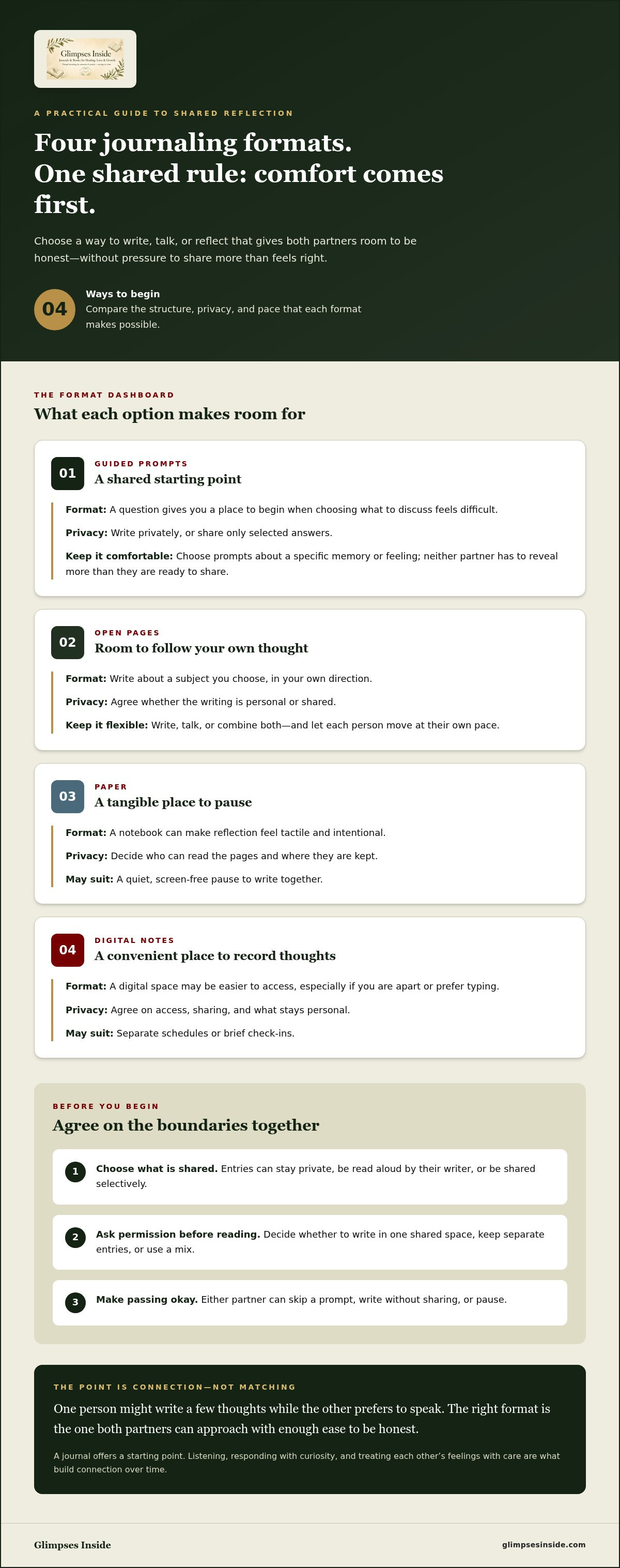
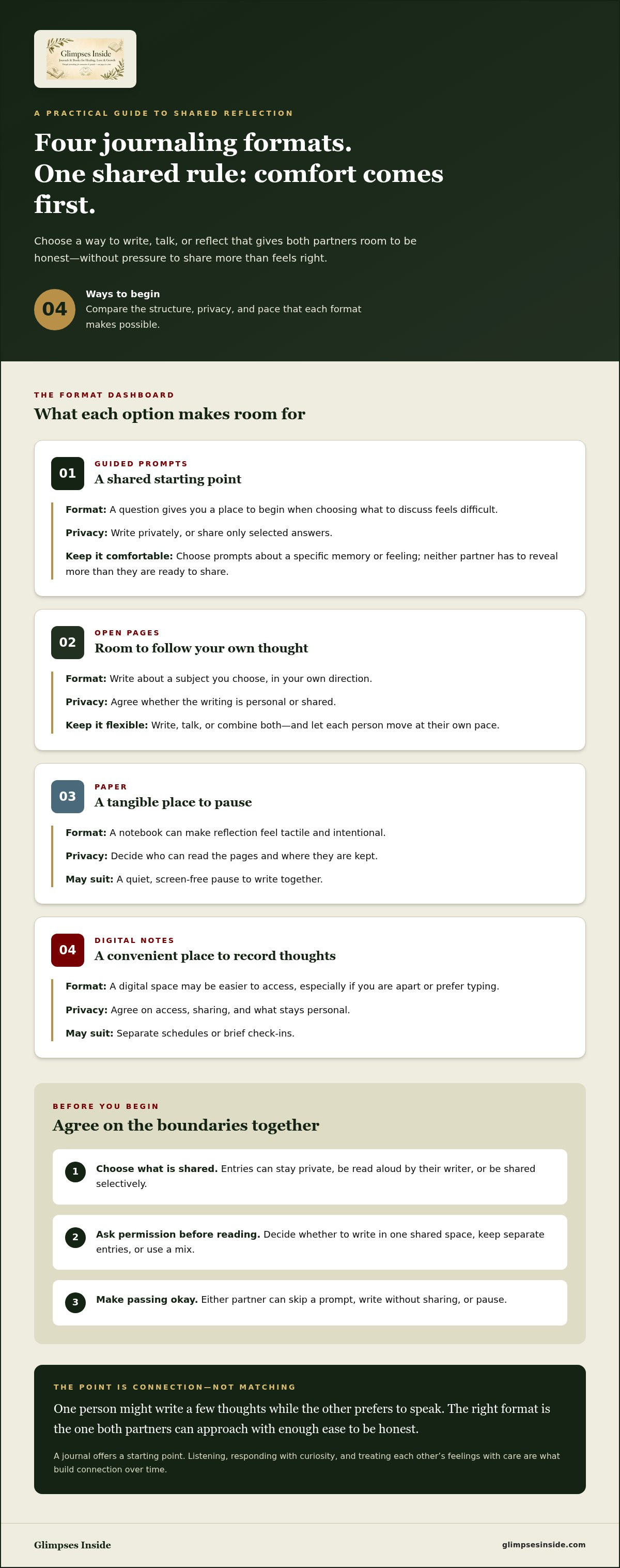
Guided prompts offer a starting point when a blank page feels too wide open. Look for questions that invite a specific memory or feeling without asking either partner to reveal more than they’re ready to share. Open pages leave you free to follow a thought in your own direction. If you’re unsure, try a short session with a prompt and another with open writing before choosing a routine.
You don’t both need to write in the same way. One person might jot down a few thoughts while the other prefers to speak. A flexible approach makes room for both, as long as neither person feels pressured to match the other’s pace or level of detail.
| Choice | Format | Privacy | Pace and participation |
|---|---|---|---|
| Guided prompts | Offers a shared starting point | Write privately or share selected answers | Helpful when deciding what to discuss feels difficult |
| Open pages | Leaves room to choose your own subject | Agree whether writing is personal or shared | Move at your own pace; write, talk, or combine both |
| Paper | Creates a tangible place to write together | Decide who can read the pages and where they’re kept | May suit a quiet, screen-free pause |
| Digital notes | Offers a convenient place to record thoughts | Agree on access, sharing, and what stays personal | Can work for separate schedules or brief check-ins |
Paper or digital journaling: what matters for shared reflection?
Paper can make reflection feel tactile and intentional: open a notebook, settle in, and write. Digital notes may be easier to access, especially if you’re apart or prefer typing. Neither format is automatically more intimate. Choose what both partners feel comfortable using, and agree on what will be shared. Privacy is part of that comfort, not a detail to settle later.
Before you begin, decide whether you’ll write in one shared space, keep separate entries, or use a mix. Agree that reading someone’s words requires permission. If a physical publication helps you make room for personal reflection, explore reflective publications, including Just 30 Days. You can use a reflective publication as a companion to your own practice, then decide what, if anything, to bring into conversation.
Will journaling feel awkward or expose too much? Set gentle boundaries first
It can feel vulnerable to put a private thought on the page, especially if you’re unsure who will read it. With journals for emotional intimacy, sharing should be invited, never required. Before you begin, decide together what feels comfortable: entries can stay private, be read aloud by their writer, or be shared selectively. Agreeing on this first helps each person know what to expect.
Make passing an option, too. Either partner can skip a prompt, write without sharing, or ask to pause without explaining why. A prompt is an invitation, not a test of trust. You might say, “I’d rather pass on this one,” and move on without trying to persuade or interpret the choice.
How to make vulnerable prompts feel emotionally safer
Start with subjects that feel closer to the surface: a small moment when you felt understood, something you appreciated, or a hope for the coming week. Let each person choose whether to write, speak, or simply listen. If a question brings up more emotion than either of you wants to hold in that moment, close the journal and take a break. You can return later, choose a gentler prompt, or leave the question unanswered.
Before someone shares, ask what kind of response would help. They may want quiet attention, a question, or practical ideas. Listening first can prevent a tender moment from turning into an unwanted debate or problem-solving session.
What to do when partners open up at different speeds
Different comfort levels don’t automatically mean one person is unwilling to connect. One partner may need time to find words; the other may think aloud. Let the pace vary. Keep early sessions short and choose concrete questions, such as “What helped you feel cared for this week?” rather than asking for a complete account of every difficult feeling.
Agree on one simple way to respond, such as listening without interruption until the speaker says they’re finished. Then reflect back what you heard: “It sounds like that moment stayed with you.” You don’t have to agree with every detail to show you’re trying to understand. If either person starts to feel pressured, return to your boundaries and pause. A sense of safety is built by respecting choices, not extracting disclosures.
A simple weekly journaling ritual for deeper emotional intimacy
A shared ritual doesn’t need a special setting, a long list of questions, or a perfect mood. Choose a time that feels realistic and return to it regularly. A brief weekly check-in can give you room to notice what’s going well and what you’d like to understand more deeply. With journals for emotional intimacy, a steady, comfortable rhythm matters more than how often you write.
A four-step shared reflection practice
Try this simple sequence. Adjust it whenever it stops feeling comfortable or useful.
- Choose one prompt. Agree on a question and a comfortable amount of time before you begin. Keep it brief enough to fit into an ordinary week.
- Reflect first. Write privately or sit quietly with your thoughts. Share a written response, speak instead, or take turns doing both.
- Listen, then check in. Let each person finish without interruption. Ask, “Would you like me to listen, ask a question, or offer a response?”
- Close with care. Name one takeaway or something you appreciated about the conversation. Resist scoring the answers or deciding whether either person did it “right.”
The prompt can be simple: “Can you remember a moment this week when you felt seen or supported? What happened, and what made it meaningful?” One person might describe a practical gesture; the other might remember a quiet moment of attention. The point isn’t to give matching answers. It’s to learn what care looks like to each of you.
Prompts that invite closeness without demanding perfection
Choose open questions that welcome a real example, not a correct answer. You might ask, “What’s something I did that you appreciated?”, “When did you feel understood this week?”, or “What’s one thing you’d like me to be curious about?” Each partner can change the wording, answer in a few words, or pass. The practice should fit your voices, not make them sound scripted.
Keep the ritual flexible. If a week gets busy, return to it when you can rather than treating a missed session as failure. A notebook or other reflective publication can offer a tangible place to pause and gather your thoughts. If you’d like a companion for your own reflection practice, explore reflective publications, including Just 30 Days. Let each conversation end with one small intention for the next: perhaps asking a follow-up question, offering appreciation, or listening without rushing to respond.
Make reflection a gentle habit with a journal that fits your journey
The most useful practice is one that feels comfortable enough to return to. Choose what suits you both: write together or reflect individually; follow a guided question or use open pages; keep entries private or share selected thoughts by invitation. The right balance can change over time. There’s no single format you have to get right.
Journals for emotional intimacy can give you a place to notice feelings and gather your thoughts, but they can’t promise a transformed relationship. A journal is a companion to conversation, not a replacement for listening, care, or the choices you make together. Look for small shifts instead of a dramatic turning point: perhaps you listen with less interruption, express a need more clearly, or remember to ask how something felt.
How to keep the practice alive after the first few entries
Let the habit stay flexible. Return to a question that helped you feel understood rather than trying to fill every page. If your schedules change, choose a different moment; if one format stops feeling natural, adjust it. You might write separately and share one thought, or set the pages aside and talk. Consistency doesn’t mean following a rigid plan. It means making room to reconnect when it feels right.
Notice what’s becoming easier. A small change, like asking “Would you like me to listen or help think this through?” can matter. So can being able to say, “I need a little time before I answer.” These aren’t scores or proof that everything is fixed. They’re gentle signs that reflection may be helping you understand one another more clearly.
Choose a reflective companion for the next step
If a physical publication helps you slow down and make space for your own thoughts, choose one that fits your preferred routine. Keep it nearby for quiet individual reflection, then bring a thought into conversation only if you want to. Glimpses Inside offers reflective publications, including the Just 30 Days series. Use them as a companion to your personal reflection and let your own approach to sharing shape the practice.
Begin with one page, one honest thought, or one quiet moment of attention. There’s no need to rush. Explore Glimpses Inside and find a reflective publication or curated gift box to accompany your next step.
Take One Gentle Step Toward Feeling Closer
Journals for emotional intimacy work best when they fit both partners: shared or individual, guided or open, private or selectively shared. Begin with a question that feels manageable, make passing an option, and treat the page as an invitation to listen rather than a promise of instant change.
Let your practice grow at its own pace. A few thoughtful words, a clearer request, or a moment of patient listening can be enough for today. Small steps count.
For a quiet companion to personal reflection, explore Glimpses Inside, owned and operated by author Ianthe Writes. Its reflective publications include the Just 30 Days series, and curated gift boxes offer another way to engage with its books and journals. Explore reflective publications and gift boxes from Glimpses Inside and choose a next step that feels right for you.
Frequently Asked Questions
Can journals help couples build emotional intimacy?
Yes, journals can offer a calm starting point for sharing thoughts and listening with care. Journals for emotional intimacy work best as an invitation to understand one another, not as a test or a promise that the relationship will change. You can write, talk, or simply listen. If a prompt feels uncomfortable, pause, skip it, or choose a gentler question that feels manageable for both of you.
How do couples use a journal together?
Choose one prompt, agree on what stays private, and decide whether you’ll write, speak, or combine both. Take turns responding without interruption. After each person shares, ask whether they’d like listening, questions, or support rather than assuming what would help. Keep early sessions brief and close by naming one thing you appreciated or learned. A flexible ritual can be easier to return to than a demanding routine.
What should I write in a journal for emotional intimacy?
Start with a specific question that invites a manageable reflection. You could write about a moment when you felt understood, something you appreciate about your partner, or one small way you’d like to feel supported. Share only what feels comfortable. Treat each response as a chance to understand your partner’s experience, not as evidence to use in an argument. Your answers don’t need to match or sound polished to be meaningful.
Is it normal to feel awkward journaling with a partner?
Yes, feeling awkward can be part of trying a new way to talk about emotions. Start with a light prompt, keep the session brief, and agree that either person can pass without explaining why. If speaking feels difficult, write privately first and choose what, if anything, to share. Awkwardness doesn’t mean you’ve failed. It may simply be a cue to slow down, adjust the question, or try again another time.
Should couples share everything they write in a relationship journal?
No, using a journal together doesn’t mean giving up personal privacy. Before starting, agree which entries are private, which thoughts might be shared, and whether reading aloud is optional. Ask before looking at or discussing a partner’s writing. If one person wants to keep an entry to themselves, respect that boundary without pressing for access. Clear expectations can help reflection feel voluntary and safer for both partners.
How often should couples use an intimacy journal?
There’s no single schedule that works for every couple. Begin with a rhythm that feels realistic, such as a short check-in when you both have time and energy. Focus on whether the practice supports listening and understanding, rather than how many pages you complete. If journaling begins to feel like pressure, adjust the routine, take a break, or return to it when it feels welcome again.
Can journaling replace couples therapy?
No, journaling can support reflection and conversation, but it isn’t a substitute for professional help when a relationship needs it. A journal can’t assess your situation, provide therapy, or guarantee resolution. If conversations feel unsafe, distressing, or persistently stuck, consider seeking appropriate professional support. Keep journaling voluntary, and use it only when both partners feel comfortable and the practice remains helpful.