Reflective Journaling: A Gentle Guide to Growth
October 5, 2026 · 14 min read

What if personal growth comes less from dramatic breakthroughs and more from noticing what keeps returning? Reflective journaling for growth gives you a way to pause after an experience, make sense of what it stirred in you, and spot patterns you might otherwise miss. You don’t need polished pages or specialist language, and you don’t need to write every day.
If a blank page feels daunting, or your entries seem to circle the same thoughts, a simple starting point can help. In this guide, you’ll learn what reflective journaling is, how it differs from simply recounting your day, and how to find a flexible rhythm that doesn’t become another obligation. You’ll also find prompts for noticing patterns, exploring what your experiences mean to you, and choosing considered next steps. Growth can begin quietly, with one honest observation.
Key Takeaways
- Use a simple sequence to reflect: describe what happened, notice your response, explore what it may mean, then choose a next step.
- Keep entries brief and honest. A few thoughtful lines can reveal more than a polished account of the whole day.
- Choose prompts that connect to a current feeling, decision, relationship, or recurring moment to make reflective journaling for growth personally relevant.
- Shape the practice around what feels comfortable, from your writing format to the time and place, instead of following a rigid routine.
- If you’d like more structure, a guided publication such as Just 30 Days can offer an optional companion for reflection.
What Is Reflective Journaling for Growth, and What Can It Offer?
When days blur together, it can be hard to know what you want to change. You may sense that something feels off, or notice the same kind of moment bothering you, without knowing what to do with that feeling. Reflective journaling for growth gives you space to slow down and look more closely, without demanding an immediate answer.
Reflective journaling means writing about an experience to explore what it meant to you, how you responded, and whether it connects to a recurring pattern. Rather than stopping at “what happened?”, you might ask, “What did I feel?” or “What might I need?” The idea is similar to reflective writing, which pairs an account of an event with consideration of its meaning.
It isn’t the same as keeping a gratitude list, though gratitude can be one part of what you explore. Your writing also doesn’t need to be elegant or complete. A crossed-out sentence, a few plain observations, or an unanswered question can help you pay attention to your inner experience. The value is in noticing, not in producing a page that sounds wise.
How Is Reflective Journaling Different from Keeping a Diary?
A diary often captures events: “I had lunch with a friend, then we disagreed about our plans.” Reflection adds curiosity about your response: “I felt tense when the plan changed. Was I worried about being left out, or simply tired?” Neither interpretation has to be right. Even a diary entry can become reflective when you pause to consider what an event meant to you.
What Does Personal Growth Look Like on the Page?
Reflective journaling for growth is the practice of writing about experiences to understand your reactions, notice recurring patterns, and consider a thoughtful next step. Growth on the page may be small: recognizing that you often say yes before checking how you feel, or noticing that rest matters more than you had admitted. Over time, entries may reveal themes, but they can also leave questions open. You’re allowed to be unsure while you learn.
Reflection can support self-understanding, but it doesn’t promise a breakthrough or make difficult experiences disappear. If writing brings up distress that feels hard to manage, pause and seek support from a qualified mental health professional. Journaling can sit alongside professional care, but it isn’t a replacement for it.
How to Reflect on an Experience Without Getting Stuck in the Story
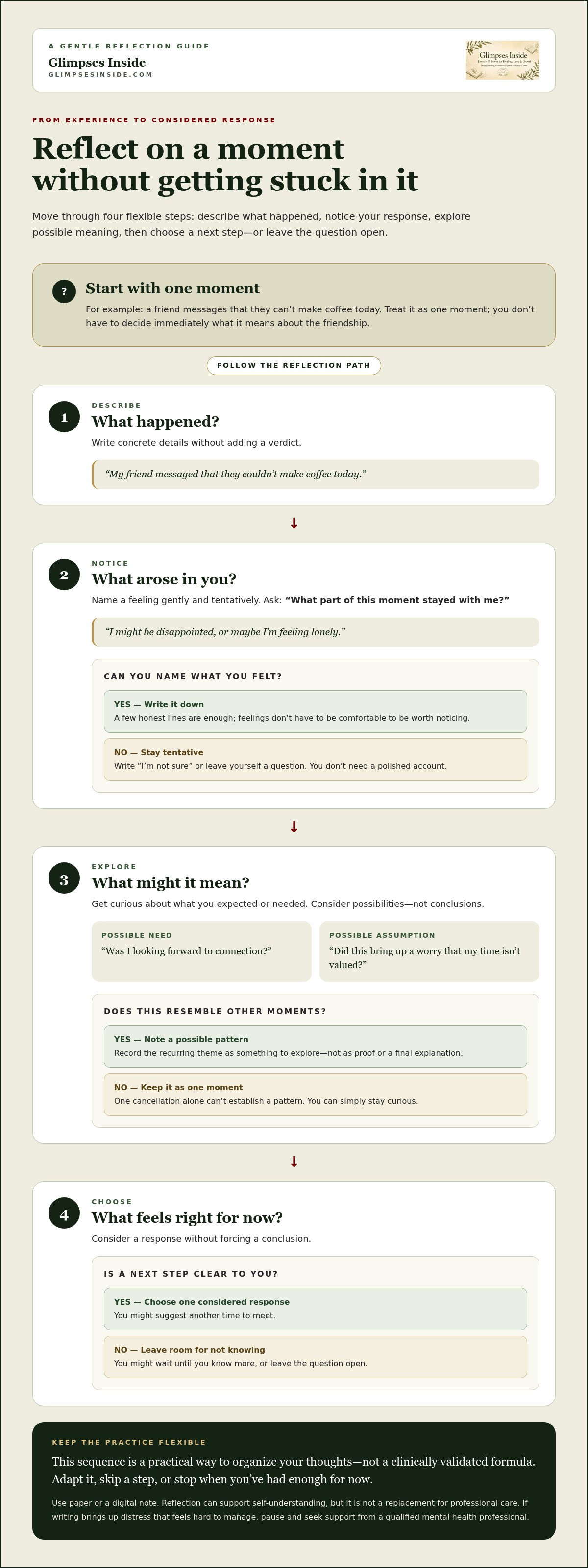
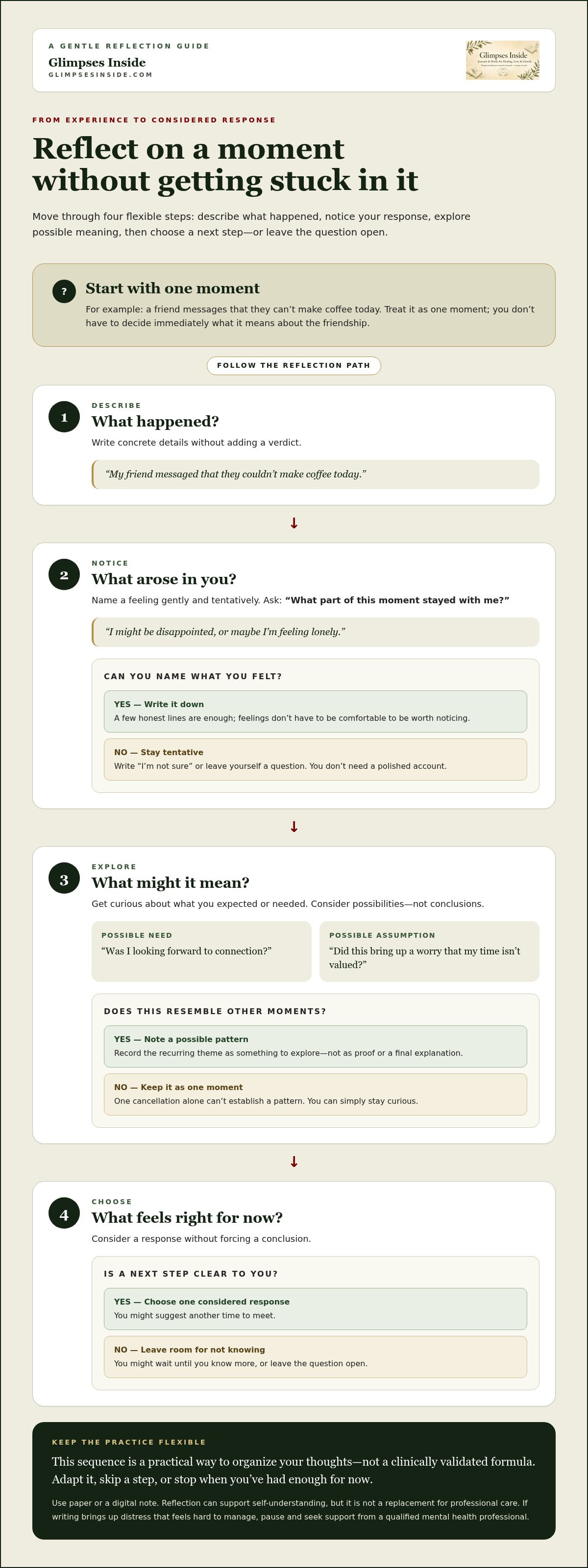
Reflection can help you look at a moment without replaying it endlessly. Try a flexible sequence: describe, notice, explore, and choose a next step. It’s a practical way to organize your thoughts, not a clinically validated formula. Adapt it, skip a step, or stop when you’ve had enough for now.
Imagine a friend cancels coffee shortly before you’re due to meet. You might feel disappointed, but you don’t have to decide immediately what the cancellation means about the friendship. Treat it as one moment, with room for more than one explanation.
Start with What Happened and What You Felt
Describe: Write the concrete details without adding a verdict: “My friend messaged that they couldn’t make coffee today.” Notice: Name what arose, gently and tentatively: “I might be disappointed, or maybe I’m feeling lonely.” Feelings aren’t wrong or excessive just because they’re uncomfortable. Ask yourself, “What part of this moment stayed with me?” A few honest lines are enough. You don’t need a polished account.
Explore Meaning, Patterns, and One Next Step
Explore: Get curious about what you expected or needed. Were you looking forward to connection? Did the change bring up an assumption that your friend doesn’t value your time? Treat these as possibilities, not facts. A resource from Northern Illinois University describes reflective journals as personal records of learning experiences, a format that can help make sense of an experience over time.
Choose: Consider whether this resembles other moments, while remembering that one cancellation alone can’t establish a pattern. You might suggest another time to meet, wait until you know more, or leave the question open. Reflective journaling for growth isn’t about forcing a conclusion. It’s a way to notice what matters and consider a response that feels right for you.
You can use the same steps on paper or in a digital note. If a tactile, guided format would help you settle into reflection, Just 30 Days offers a structured companion.
Reflective Journaling Myths: Must You Write Daily or Find an Answer?
Reflection can feel like another task if you turn it into a streak to maintain or a puzzle you must solve. Reflective journaling for growth doesn’t require perfect consistency, a fixed number of minutes, or a lesson in every entry. Curiosity is welcome, but pressure isn’t necessary.
Prompts can make it easier to begin, especially when your thoughts feel scattered. Try asking, “What’s taking up space in my mind?” or “What would I like to understand better?” Prompts are a doorway, not a rule. Some days you may have a clear question; other days, free writing or noting one feeling may be enough. You don’t have to uncover a profound insight each time. An honest observation, or an unanswered question, still counts as reflection.
Harvard Medical School discusses how reflective journals can help learners cultivate essential skills, including critical thinking and self-assessment. That educational context offers a useful reminder: reflection is a way to look more carefully at experience, not a promise of instant personal change or a guaranteed result.
Is Daily Journaling Necessary for Personal Growth?
No single schedule suits everyone. Brief, regular notes can help you track small shifts, while occasional longer entries may give you room to explore a complicated experience. Either rhythm can work if it fits your life and feels supportive rather than burdensome. Write when something stays on your mind, or make a loose appointment with yourself when you have the space.
If you miss a few days, there’s nothing to catch up on. Begin with what’s present now. A journal isn’t a record of perfect attendance, and a gap doesn’t erase what you’ve already noticed.
What If Writing Brings Up Uncomfortable Feelings?
Reflection can touch a tender place. You can pause, shift to a lighter subject, write a single sentence, or close the journal. Keeping your words private and choosing a manageable prompt may help you stay within your comfort. You’re allowed to decide how much to explore.
If difficult feelings persist or feel hard to manage alone, consider seeking support from a qualified mental health professional. Journaling may complement that care, but it can’t replace it. Let the practice be gentle enough to return to, not something you have to push through.
Build a Reflective Journaling Practice That Fits Your Real Life
A practice is easier to return to when it fits the life you already have. You don’t need a perfect desk, a long stretch of quiet, or a fixed schedule. Start with a few choices that make writing approachable.
- Time: Choose a moment that often has a little breathing room, such as after breakfast or before bed.
- Place: Find somewhere quiet enough to gather your thoughts. It doesn’t have to be completely silent.
- Format: Use a notebook, loose paper, or a digital note. Choose what feels comfortable, easy to access, and private enough for you.
Choose a Rhythm and Format You Can Return To
Paper can offer a tactile pause away from screens; digital writing may be more convenient to open and keep with you. Neither is inherently better. Consider your comfort, access, and privacy, then change formats if your needs shift.
Rather than creating a demanding schedule, attach reflection to a quiet moment that already exists. One sentence about what stayed with you can be a complete entry. A brief practice isn’t a lesser version of journaling. It’s a way of showing up that may feel manageable today.
For another perspective on making room for reflection, read the 30-day journal for clarity guide.
Use Prompts to Open a Door, Not Dictate an Answer
Choose a prompt connected to something on your mind rather than trying to write about everything. You could ask:
- What moment from today is still with me, and why might it matter?
- What do I need in this situation that I haven’t named yet?
- Was there a moment in a relationship when I wanted to say no, ask for something, or be understood?
- What small change might make this part of my day feel more supportive?
Let the questions guide you, not decide what your answers should be. Skip anything that feels unhelpful or too personal that day. If you revisit entries, look gently for themes in your feelings, needs, or responses. A recurring note is something to explore, not a diagnosis or proof that you must act a certain way. For a wider view of inner growth, read the women’s personal growth guide.
For a tangible guide to reflection, Just 30 Days for structured reflection can accompany your own rhythm.
Continue Your Reflective Journaling Journey with Gentle Structure
Reflection doesn’t have to end with a perfect explanation. Notice what’s true for you, explore it gently, and let one small next step be enough. You might carry an insight into an everyday choice, such as pausing before agreeing to a plan or making room for rest. The choice can be modest, or it can be to wait and see.
When a Guided Journal May Feel Helpful
Sometimes the hardest part is knowing where to begin. A guided publication can give you a starting point if an open page feels too wide. It’s an option, not a requirement. Adapt a prompt to fit your circumstances, skip one that doesn’t feel right, or move at a pace that feels comfortable.
Just 30 Days is a reflective publication series for readers who would like a tangible companion for personal reflection. You don’t need to treat it as a test or expect a particular result. Let its structure support your own questions and observations, while leaving room for your experience to unfold in its own time.
Make Room for Reflection Beyond the Page
A journal can help you notice something; your daily choices give you a chance to respond. If you’ve realized you need more quiet after a busy day, perhaps you protect a few minutes for yourself. If a question about a relationship remains open, you might keep it in mind rather than rushing to a conclusion. Reflection is ongoing. It doesn’t need a finished answer to matter.
That’s the heart of reflective journaling for growth: making space to listen to your experience without demanding that every entry change your life. Some days you may write a page. Other days, a single line may be enough to mark what you’re feeling or what you need. You can return when you’re ready.
If you’d like a clear, tangible companion for that practice, you’re warmly invited to explore the Just 30 Days series. One honest sentence is a beginning too.
Let One Honest Observation Be Your Beginning
Personal growth doesn’t have to arrive as a sudden breakthrough. Reflective journaling for growth can help you notice what keeps returning, explore your reactions with care, and consider one small next step. Write briefly, choose a rhythm that fits your life, and leave some questions open. The practice is yours to shape.
If a little structure would make it easier to begin, Glimpses Inside offers the Just 30 Days series as a reflective publication and tangible companion for personal reflection. Glimpses Inside is owned and operated by author Ianthe Writes, whose work includes reflective publications.
Explore Just 30 Days whenever you feel ready. You don’t need to have everything figured out before you start. One quiet pause, one true sentence, or one small act of listening to yourself can be enough for today.
Frequently Asked Questions
What is reflective journaling for growth?
Reflective journaling for growth means writing about an experience and considering what you felt, noticed, or learned from it. Unlike a simple record of events, it makes room to explore meaning and recurring responses. Growth doesn’t have to look like a sudden breakthrough. It might begin with naming a feeling more clearly, recognizing a need, or noticing one choice you’d like to approach differently next time.
How do you start reflective journaling as a beginner?
Start with one recent moment and write a few concrete details about what happened. Then name what you felt and ask, “What part of this experience stayed with me?” You don’t need a special notebook, a perfect prompt, or a long writing session. If the blank page feels difficult, begin with one sentence. You can stop there if that feels like enough for today.
Do you have to journal every day for personal growth?
No, you don’t have to journal every day. A helpful rhythm is one you can return to without making reflection another source of pressure. You might prefer brief, frequent entries, or write when a decision or feeling needs attention. Missing days doesn’t erase what you’ve already explored. Begin again when it feels useful, without catching up or following someone else’s schedule.
What should I write about in a reflective journal?
Write about a specific moment, decision, conversation, or feeling that has stayed with you. You could ask what you needed, what surprised you, or whether a familiar response appeared. A prompt can help you begin, but you can also follow a question of your own. You don’t have to find a lesson, explain everything, or share every thought on the page.
Can reflective journaling help you understand recurring patterns?
It can give you a place to notice feelings, situations, or responses that appear repeatedly over time. One entry is only a snapshot, though, not proof of a fixed pattern or a diagnosis. If you reread earlier writing, approach it with curiosity rather than judgment. Look for themes or questions you may want to explore, and allow your understanding to change as you learn more.
What should you do if journaling brings up difficult feelings?
You can pause, close your journal, or turn to a lighter subject if writing feels uncomfortable or overwhelming. Keeping an entry brief may feel more manageable, and you don’t have to explore every thought alone. If distress persists or feels difficult to manage, consider reaching out to a qualified mental health professional. Journaling may support reflection, but it isn’t a substitute for professional care.
Is reflective journaling better on paper or digitally?
Neither paper nor digital journaling is automatically better for everyone. Writing by hand may feel tactile and help you slow down, while a digital note can be convenient to access and search. Consider what feels comfortable, accessible, and private for you. The format matters less than having a place to write honestly and return to reflection when it feels useful. You can also switch formats over time.