Reconnecting Through Shared Reflection: Small Moments That Bring You Closer
October 3, 2026 · 16 min read

What if reconnecting didn’t begin with one big, perfectly worded conversation, but with a small moment of being heard? When everyday talk stays focused on plans and tasks, reconnecting through shared reflection can feel tender, even awkward. You may want to understand each other better while worrying the conversation could drift into blame or pressure.
That hesitation makes sense. Reflection doesn’t mean revisiting every difficult moment or finding the right answer. It can begin by pausing, listening to what the other person experienced, and asking with curiosity instead of assuming. Small moments can make room for more warmth and understanding, at a pace that feels comfortable for both of you.
In this article, you’ll find practical ways to create space for unhurried conversation, remember what matters to each of you, and begin reconnecting through shared reflection. Simple prompts and repeatable rituals can help you listen more deeply without turning connection into another obligation.
Key Takeaways
- Choose a light memory to revisit together when a high-stakes conversation feels like too much.
- Listen to understand what the other person noticed and felt, rather than correcting their version of events.
- Use a simple sequence for reconnecting through shared reflection: choose a moment, take turns sharing, reflect back, and close gently.
- Agree on a pause if either person feels overwhelmed, and return to the conversation only when it feels right.
- Try brief written reflection before sharing, so each person has time to notice what they want to bring into the conversation.
Reconnecting Through Shared Reflection: Why Small Moments Matter
Distance doesn’t always arrive through one defining argument. It can gather quietly in busy routines, feelings left unspoken, or small moments when attention is elsewhere. Shared reflection offers a way to pause and notice what those moments meant to each of you, without assuming you experienced them in the same way.
Shared reflection is calmly revisiting an experience together to understand what each person felt and noticed, not to assign blame or solve everything at once. It isn’t a demand for agreement, instant closeness, or a dramatic disclosure. It’s a chance to be curious about one another’s perspective. A broad overview of interpersonal communication describes how people communicate to establish and maintain relationships. Shared reflection brings that everyday exchange into focus, one memory at a time.
What shared reflection can offer a relationship
Attentive listening can help each person feel heard, even when their memories or interpretations differ. For example, you might revisit a quiet walk and discover that one person remembers the conversation while the other treasures the comfortable silence. Neither version has to be the correct one. Both can add something to the picture you hold together.
Remembering meaningful experiences can also bring shared history back into view. A kind gesture, a moment of laughter, or a time you worked through an ordinary challenge may remind you of care that gets overlooked amid daily tasks. The value isn’t in proving the relationship is perfect. It’s in making room for what each of you noticed and why it mattered.
When a reflective conversation may feel difficult
Starting can feel awkward. You might worry about being criticized, saying the wrong thing, or opening a conversation you don’t know how to finish. Those hesitations are understandable, especially if reflection has previously turned into defending positions or searching for fault.
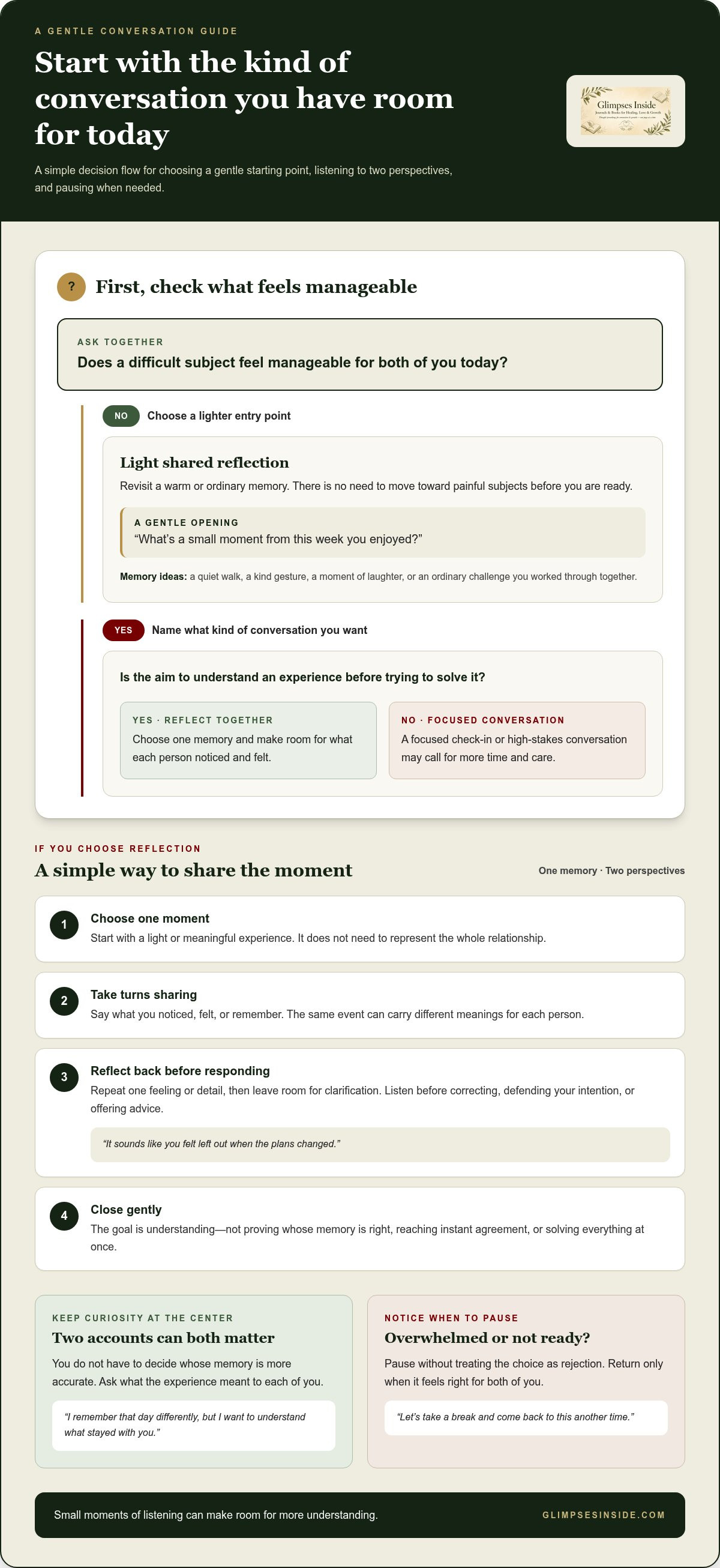
Begin somewhere lighter if that feels safer. Ask, “What’s a small moment from this week you enjoyed?” or choose a positive memory you both remember. You don’t need to move toward painful subjects before you’re ready. A gentle beginning still counts.
Pay attention to how the conversation feels as it unfolds. If either person becomes overwhelmed or doesn’t want to continue, pause without treating that choice as rejection. You could say, “Let’s take a break and come back to this another time.” Reconnecting through shared reflection is an invitation, not a test. Sometimes closeness begins simply with listening and letting the moment be enough.
How Listening and Memory Make Shared Reflection Feel Connecting
In reconnecting through shared reflection, remembering is only one part of the practice. The other is listening to how the memory lives for someone else. One person recalls a moment; the other gives it their attention. Then both can make room for what they noticed, felt, or understood, without turning the memory into a verdict.
Curiosity makes room for two perspectives without asking either person to disappear. Listening to understand means staying with the other person’s meaning before correcting a detail, defending your intention, or preparing your reply. A pause can help. Silence isn’t a gap you have to fill; it can give a thought time to settle.
Listen without rushing to fix the moment
Try reflecting back one feeling or detail before offering advice: “It sounds like you felt left out when the plans changed.” Then leave room for the other person to clarify. Open questions such as “What stands out to you now?” invite more than a question that hints at the answer you expect. Understanding comes first. Solutions can wait until they’re welcome.
Illustrative example: One person remembers a family gathering as lively and fun. The other remembers feeling quiet and overlooked. Rather than replying, “But everyone was happy to see you,” the listener might say, “I remember the energy differently. What was that moment like for you?” This doesn’t promise agreement or resolve a deeper concern. It gives each account space.
Hold two memories without forcing agreement
Shared memories aren’t always shared in the same way. Details can differ, and the same event can carry different feelings for each person. You don’t have to decide whose memory is more accurate to ask what it meant to each of you. Try: “I remember that day differently, but I want to understand what stayed with you.”
Keep the memory out of the role of evidence. It isn’t proof that one person cared more, a verdict on who was right, or a tool for winning an old argument. If the details become a point-by-point contest, return to the feeling underneath: “What do you most want me to understand?”
The Greater Good Science Center at UC Berkeley explores research on how reminiscing together may relate to closeness and relationship satisfaction. A shared memory can be a gentle place to begin, not a guarantee of a particular outcome. If writing helps you notice what you’re feeling before you speak, reflective reading can be a quiet companion. Explore reflective publications and gift boxes.
Shared Reflection Versus a Difficult Talk: Choose a Gentle Starting Point
Not every meaningful conversation needs to begin with the hardest subject. Reconnecting through shared reflection can start with a warm memory or a moment of appreciation, while a focused check-in or high-stakes conversation may call for more time and care. Choose the kind of conversation that matches what you both have room for today.
| Conversation | Readiness | Suggested opening | When to pause |
|---|---|---|---|
| Light shared reflection | You both feel open to a gentle exchange. | “What’s a small moment we’ve enjoyed lately?” | If it begins to feel pressured or one person wants to stop. |
| Focused relationship check-in | You have agreed on a topic and have some time to listen. | “Could we talk about how we’ve been feeling about our routines?” | If either person feels too tired, defensive, or overwhelmed to continue. |
| High-stakes conversation | You’re prepared to discuss a serious or unresolved concern. | “Can we set aside time to talk about something important?” | If the conversation feels unsafe or too intense to continue constructively. |
How to tell whether to begin lightly or go deeper
A positive memory or simple appreciation may be a more comfortable first step if meaningful conversation feels unfamiliar, or if you’re both tired and easily distracted. If there’s unresolved hurt, a quick reflection exercise may not give it the attention it needs. Treat that as a separate, intentional conversation. Before you begin, agree on the topic and check whether you both have the space to talk.
Reflection can help you listen and understand, but it isn’t a substitute for addressing urgent concerns or seeking appropriate support. Let the conversation fit the issue, rather than asking a gentle ritual to carry more than it can.
What to do when one person is not ready
A pause, a “no,” or a change of subject is a valid boundary. It isn’t an obstacle to overcome with better wording or persuasion. You might say, “That’s okay. Would you like to leave it here?” If both of you want to return to the topic, choose another time together. If not, respect the answer and leave the invitation open without pressure.
A reflective book can also offer a quiet way to notice your own feelings before deciding what to share. The article about deepening emotional intimacy through a reflective book can offer another perspective on that individual practice.
A Gentle Shared Reflection Ritual You Can Try Together
This practice is an invitation, not a test of your relationship. One conversation may feel meaningful, ordinary, or a little awkward, and it doesn’t have to resolve distance. Adapt the steps to suit you both, or leave them for another day. The heart of reconnecting through shared reflection is making room for each person to choose what they’re ready to share.
Set a pace that feels comfortable for both people
Choose a moment when neither of you feels rushed. Put distractions aside if that feels helpful, and agree on one question or memory rather than trying to cover several topics. You might also choose a simple signal, such as saying “pause,” that either person can use to stop or change direction.
- Agree on the moment. Ask, “Would you be open to sharing a memory together now, or would another time feel better?”
- Choose one memory. Pick a meaningful shared moment, a small kindness, or an experience you’ve understood differently over time. Try a prompt like, “What’s a little thing one of us did that stayed with you?”
- Take turns. One person shares while the other listens. Then switch, without needing to tell the story in the same way.
- Reflect back. Offer a simple response such as, “It sounds like that meant a lot because…” Give the other person room to correct or add to your understanding.
- Close gently. Ask whether you’d like to keep talking, end here, or revisit the practice another time.
Either person can skip a prompt, pause, or reschedule. A choice to stop doesn’t need to be explained or persuaded away. The ritual works best when both people remain free to take part at their own pace.
End with a small next step, not a promise
If it feels natural, each of you can name one thing you appreciated hearing. You might simply say, “I’m glad I know that now.” Or close with a small mutual intention, such as choosing another moment to reflect together. There’s no need to promise that things will change after one conversation. A gentle ending can be enough.
Written reflection can help you notice your own feelings before deciding what to share. The guide to a 30-day journal for clarity offers an individual companion to that process. For reflective reading to explore in your own time, browse reflective publications.
Keep Reconnecting Through Reflection, Reading, and Small Rituals
A ritual doesn’t need its own place on a crowded calendar. You might share a brief check-in over tea, during a walk, or at a quiet point in a routine you already have. Keep it simple enough to return to, and flexible enough to fit real life. The point isn’t to maintain a perfect streak. It’s to make space for attention when you both have it to give.
Build a rhythm that leaves room for real life
Choose a pace that feels mutual, whether that means a regular moment or an occasional conversation when you’re both available. If you miss a day or a week, there’s no need to catch up or criticize yourselves. Just begin again when it feels welcome. From time to time, ask, “Does this still feel comfortable for both of us?” You can change the format, pause, or let the ritual go. Small moments of attention can matter without needing to prove a measurable result.
Let personal reflection support shared connection
Writing privately can help you notice a feeling before deciding whether to share it. You might jot down what stayed with you from the day, what you appreciated, or what you’re still making sense of. Your notes belong to you. Journaling doesn’t mean you have to show what you wrote or explain every feeling. Each person chooses what to keep personal and what, if anything, to bring into a conversation.
A reflective book can offer a quiet companion for this individual pause. The Just 30 Days series from Glimpses Inside supports personal growth and reflection. It can sit alongside a shared ritual without being a relationship program or a substitute for listening to each other. Read, reflect, and decide for yourself what feels meaningful to carry into the conversation.
Reconnecting through shared reflection can be less about creating a new obligation and more about returning, when you can, to a small moment of genuine attention. Some days you may have a memory to share. Other days, a check-in may be as simple as asking how the week has felt. Let the practice change with your needs.
If reflective reading feels like a helpful companion to your own quiet moments, explore Glimpses Inside’s reflective publications and curated gift boxes. Let a book or journal offer a prompt for your own pause, then choose what, if anything, you’d like to share.
Let One Small Moment Be Your Starting Point
Reconnecting through shared reflection doesn’t require a perfect conversation. It can begin with one memory, a question asked with curiosity, and the patience to hear an answer without rushing to fix or correct it. Choose a light starting point when that feels right, and remember that either person can pause or return another time.
A brief ritual can fit into a familiar part of your day, while private writing may help you notice what you’re ready to share. Neither needs to become another obligation. Small, willing moments of attention are enough to begin.
Just 30 Days from Glimpses Inside offers a resource for personal growth and reflection. Glimpses Inside, owned and operated by author Ianthe Writes, also offers curated gift boxes alongside its reflective publications. Explore Just 30 Days and gift boxes to make space for reflection at your own pace.
Move gently. You can begin again with one thoughtful question and an open heart.
Frequently Asked Questions
What does reconnecting through shared reflection mean?
Reconnecting through shared reflection means calmly revisiting an experience together to understand what each of you felt, noticed, or took from it. The aim isn’t to prove whose memory is right or solve every difficulty in one conversation. Instead, you make room for two perspectives. You might talk about a joyful moment, a small act of care, or something ordinary that mattered more to one of you than the other realized.
How can couples start reflecting together without making it awkward?
Start with a simple invitation and a low-pressure memory. You could ask, “Would you like to share a small moment from this week that felt good?” Choose a time when neither of you is rushing, and make it clear that either person can pass or pause. Taking turns can make the exchange feel more balanced. There’s no need for a perfect opening or a deeply personal revelation to make the moment worthwhile.
Can shared reflection help when a relationship feels distant?
Shared reflection can create an opportunity to listen and understand each other when distance has grown, but it can’t guarantee that closeness will return or resolve a serious concern. A light conversation about a meaningful memory may be a gentle starting point if both people are willing. If there’s urgent distress or an unresolved issue that needs direct attention, don’t rely on a reflection exercise alone to address it.
What questions can we ask during a shared reflection?
Choose open questions that invite each person to describe their experience without steering them toward a preferred answer. For example: “What stands out to you about that day?” “What’s a small kindness you remember?” or “Has the meaning of that moment changed for you?” Ask one question at a time, and give the other person space to think. You can listen first, then ask whether they’d like to say more.
What should we do if we remember the same experience differently?
Let both memories be heard without turning the conversation into a contest over details. You might say, “I remember it another way, but I’d like to understand what it was like for you.” Then ask what the moment meant to them. A difference in recollection doesn’t automatically mean one person is dishonest or mistaken. If you find yourselves trying to win the argument, pause and return to what each person felt.
How often should we make time for shared reflection?
There’s no required schedule. Choose a rhythm that feels comfortable and realistic for both of you, such as an occasional check-in during a familiar part of the week or a conversation when a meaningful memory comes to mind. Keep it flexible so a missed moment doesn’t become another source of pressure. Check in now and then about whether the timing and format still feel mutual, and adjust if they don’t.
Can journaling support reconnecting through shared reflection?
Yes. Private journaling can help you notice what you feel before choosing what, if anything, you want to share. You might write a few lines about a memory, a moment of appreciation, or a thought that’s still taking shape. Your writing can remain personal; sharing it isn’t required. Reflective reading, including Glimpses Inside’s Just 30 Days series, may also offer a companion for individual reflection, not a substitute for conversation.