Marriage Reflection Journal: A Gentle Guide to Growing Together
September 28, 2026 · 15 min read

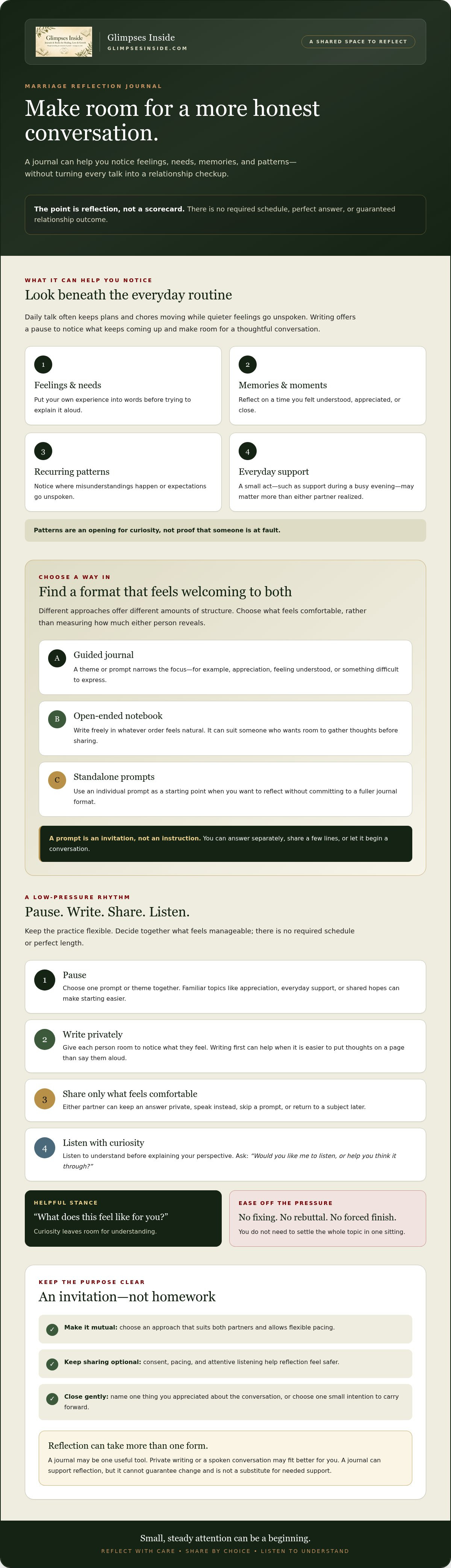
What if a marriage reflection journal helped you hear each other more clearly, without turning every conversation into a serious relationship checkup? Everyday talk can keep life moving while quieter feelings go unspoken. Writing together may feel awkward, especially if one of you finds it easier to put thoughts on a page than to say them aloud.
A journal can offer a place to pause, notice what keeps coming up, and share a little more honestly. It doesn’t need to fix every challenge or become another task to get right. A small, steady moment of attention can be enough to begin.
In this guide, you’ll learn how to choose a format that suits both of you, make reflection feel safer when your communication styles differ, and build a practice that’s realistic to maintain. We’ll also compare guided journals, blank notebooks, and standalone prompts so you can choose an approach that supports understanding without pressure.
Key Takeaways
- Use a marriage reflection journal to explore feelings, needs, memories, and patterns, not to score your relationship.
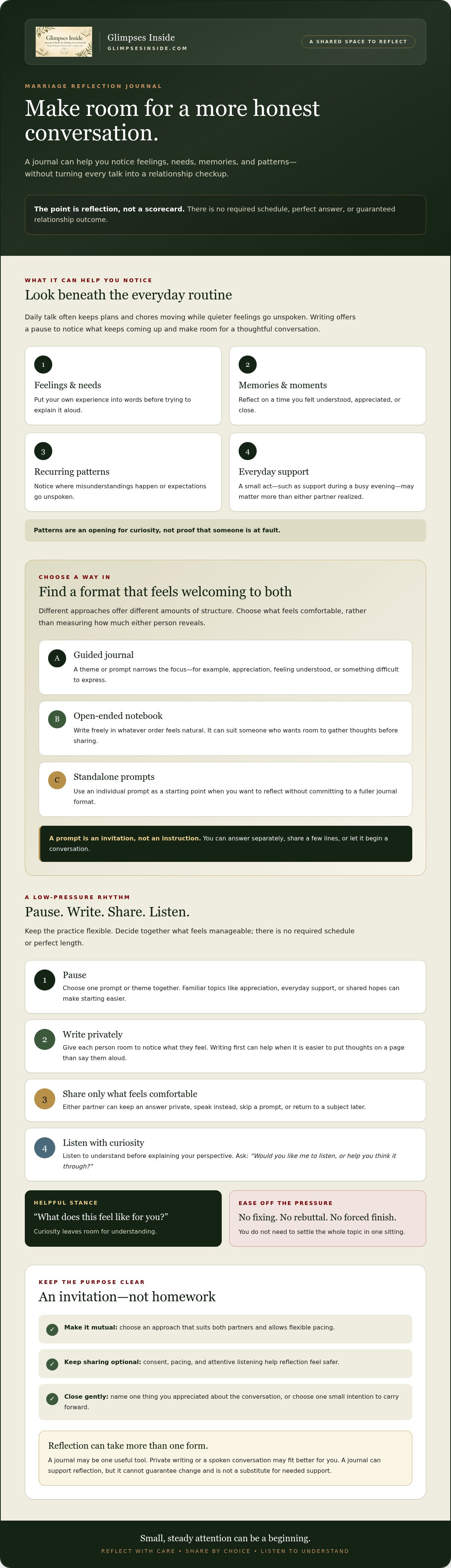
- Try a simple rhythm: pause, write privately, share only what feels comfortable, and listen with curiosity.
- Compare guided and open-ended formats, then choose one that feels welcoming to both partners and allows flexible pacing.
- Start with familiar themes such as appreciation, everyday support, or shared hopes to make journaling more approachable.
- Consider journaling as one possible reflection tool. A private or spoken approach may fit better, and a journal isn’t a substitute for needed support.
What Is a Marriage Reflection Journal, and What Can It Help Couples Notice?
Wanting deeper conversations is a tender place to begin, especially when daily talk tends to circle around plans, chores, and what needs doing next. You don’t have to know exactly what to say before you start. A marriage reflection journal offers a written space to notice feelings, memories, needs, and patterns in your life together.
There are several ways to use that space, and they serve different preferences. With private journaling, each partner writes for themselves and decides what, if anything, to share. Shared prompts give both partners the same starting point, while alternating written responses let each person respond in turn. Choose the approach that feels comfortable, rather than measuring how much either person is willing to reveal.
Some prompts invite expressive writing: putting thoughts and feelings into words rather than simply listing events. Expressive writing describes this kind of reflection, but a journal’s purpose here can stay simple: to help you pay attention to your own experience and make room for a thoughtful conversation.
A marriage reflection journal can support honest reflection, but it can’t guarantee that a relationship will change. It’s a place to notice and share, not a scorecard or a promise of a particular outcome.
How Is a Marriage Reflection Journal Different from a Diary?
A diary can hold whatever happened that day, in whatever order feels natural. Guided reflection narrows the focus with a theme, such as appreciation, a moment when you felt understood, or something you’ve found difficult to express. A prompt is an invitation, not an instruction with one correct answer.
You might answer separately, share a few lines, or use a prompt to begin talking together. Each format leaves room for choice. A partner who prefers writing can gather their thoughts first, while the other can take time to respond in conversation.
What Might Couples Learn from Reflecting Together?
Over time, entries may bring recurring themes into view: what each of you appreciates, where misunderstandings tend to happen, when you feel close, or which expectations have gone unspoken. For example, repeatedly noting how supported you feel during busy evenings might show that a small act matters more than either partner realized.
Patterns aren’t proof that someone is at fault. They’re an opening for curiosity: “What does this feel like for you?” or “What might help us understand this differently?” Reflection won’t suit every couple or every moment, but it can offer a gentler starting point than trying to find perfect words on the spot.
How Shared Journaling Can Encourage More Open, Attentive Conversations
A shared page can make room for thoughts that are hard to gather in the middle of a busy day. The aim isn’t to produce matching answers or uncover a hidden truth. It’s to pause so each partner can notice what they feel before responding.
Try a simple sequence: pause, write privately, share only what feels comfortable, then listen. One person might write about feeling overlooked during a recent decision. The other can first listen to what that experience meant, then explain their own perspective. Ask a gentle question such as, “Would you like me to listen, or help you think it through?” Curiosity leaves room for understanding; rushing to fix can close it.
Consent, pacing, and attentive listening help make shared reflection feel safer. Either partner can skip a prompt, keep an answer private, or ask to return to a subject later. A marriage reflection journal should feel like an invitation, not homework, a test, or a demand for confession.
What Does a Low-Pressure Journaling Session Look Like?
Decide together how much time feels manageable. There’s no required schedule or perfect length. Choose one prompt, then let each partner write, speak instead, or pass. After sharing, listen to understand rather than preparing a rebuttal. You don’t need to settle the whole topic in one sitting.
Close gently. Each of you might name one thing you appreciated about the conversation or choose one small intention to carry forward. The Gottman Institute describes daily rituals of connection as a way to make space for attention and appreciation. A brief, willing check-in can be more sustainable than an elaborate routine either person dreads.
What If One Partner Is Hesitant or a Prompt Feels Difficult?
Different comfort levels are normal. One partner may want to write first; the other may prefer a quiet conversation. Agree that sharing is optional, and don’t treat silence or a “pass” as proof of disinterest. You can change the prompt, take a break, or leave the topic for another time.
If reflection brings up persistent distress or serious conflict, a journal may not be enough. Consider seeking qualified outside support rather than expecting writing alone to resolve what feels difficult. The practice should respect both partners’ boundaries.
If you’re also looking for a quiet, personal reflection practice, explore reflective publications. Check the contents and intended use before choosing a publication for shared couple journaling.
How to Choose a Marriage Reflection Journal That Suits Both Partners
The best fit isn’t necessarily the most detailed or beautifully designed book. It’s the format you can both approach with some ease. Before choosing a marriage reflection journal, consider how each of you prefers to express thoughts, how much structure feels helpful, and whether you want time to write privately before sharing.
Use this comparison to guide the conversation. You don’t have to agree on every preference, but both partners should have a choice in how they take part.
| Choice | May suit you if… | Check whether… |
|---|---|---|
| Guided pages | A prompt helps you find a starting point. | The questions feel open and respectful, not like there’s one right answer. |
| Open-ended pages | You prefer to decide what matters that day. | There’s enough space to write comfortably, without needing extra structure. |
| Individual use | You want time to gather your thoughts before sharing. | Sharing is optional, and each partner can keep some reflections private. |
| Shared use | You like responding to the same prompt or reading entries together. | The format makes room for different answers and comfort levels. |
| Flexible pacing | You want to reflect when it feels useful, without a rigid routine. | You can skip prompts, pause, or return later without falling behind. |
Guided Prompts or Blank Pages: Which Format Fits Your Relationship?
Prompts can make a quiet beginning easier, especially if neither of you knows what to write. Blank pages offer more freedom to follow a thought in your own direction. A mixed format can offer both: a question to open the door, with room to take your response somewhere personal. If sample prompts are available, preview them together, especially questions about conflict, vulnerability, or expectations.
What Should Couples Check Before Choosing a Journal?
Look beyond the cover. Can each person write independently? Is sharing clearly optional? Is the text easy to read, with enough room for the kinds of answers you’re likely to give? Notice whether the language invites reflection or seems to score, diagnose, or blame a partner. Religious framing, assumptions about marriage, and milestone-focused prompts are also matters of personal fit.
Ask each other: “Would I feel included in these questions?” and “Could I pass on one that doesn’t feel right?” A journal that respects both answers is more likely to feel welcoming. For broader ideas about shared reflection, explore this guide to deepening emotional intimacy.
How to Start a Marriage Journaling Practice Without Making It Feel Like Work
A marriage reflection journal doesn’t need a perfect routine. Think of it as a small space you can return to when you both have the time and willingness to pause. The point isn’t to fill every page. It’s to make room to notice what matters.
To begin, move through these steps together:
- Agree on the purpose. Decide what you hope to make room for, such as appreciation, understanding, or shared hopes.
- Choose one prompt. Keep it open and approachable, especially for a first entry.
- Write. Take a quiet moment to gather your thoughts, or speak your response if writing doesn’t feel natural.
- Share selectively. Each person chooses what they’re comfortable sharing. There’s no need to read every word aloud.
- Close gently. Name one appreciation or one small intention, without requiring a solution or promise.
Start with familiar ground. Appreciation, everyday support, and shared hopes are often easier topics than subjects that already feel tender.
Which Prompts Make a Gentle First Entry?
Choose questions that leave room for different experiences. You might ask: “When did you feel supported by me lately?” “What’s a moment together you’ve been remembering?” or “What small gesture from me meant something to you?” These prompts don’t assume there’s a problem to uncover. Adjust the wording until it sounds natural to both of you, and skip anything that feels too personal for now.
How Can Couples Keep the Practice Flexible?
Agree on a rhythm that fits your lives, then revisit it as work, caregiving, or energy levels change. You might answer one prompt, write separately and share a few lines, or simply talk through a question. Some days, a brief reflection will feel right. Other days, it may not.
Check in now and then: “Is this still feeling useful?” If the format starts to feel like pressure, adjust it or set it aside. Consistency can mean returning when the moment feels right, not keeping a flawless streak. If you’re also curious about writing for yourself, explore this 30-day journal for clarity guide for ideas on individual reflection.
For more personal reflection ideas, explore reflective publications. Check each publication’s prompts and intended use before deciding whether it fits a shared practice.
Make Reflection a Shared Next Step, and Find a Journal That Truly Fits
A marriage reflection journal may suit you when both partners feel willing to pause, share at their own pace, and stay curious about each other’s experience. If writing side by side feels too exposing, begin privately and decide later whether to share. Or talk instead. The most useful format is the one that lets both people participate without pressure.
Notice how the practice feels, not just whether you complete a page. Does it invite honest thought, or leave one of you feeling pushed? You can adapt the approach, set it aside, or try another way of reflecting. A journal is a reflection aid, not therapy or coaching, and it can’t replace qualified support when serious conflict or distress calls for more help.
Is a Shared Journal the Right Starting Point for You?
Consider whether you can both say yes freely, ask to pause, and choose what to share. If one of you isn’t ready to read or discuss personal entries, individual journaling may be a gentler first step. If reflection brings up needs that feel beyond a journal’s scope, consider seeking appropriate outside support. There’s no single pace you have to follow.
How Can a Reflective Publication Support the Next Small Step?
A structured publication can offer a starting point for personal reflection, depending on its prompts and intended use. Glimpses Inside offers the Just 30 Days series as a reflective publication, but its suitability for shared couple journaling shouldn’t be assumed. Review the current contents before deciding whether it fits individual reflection or a practice you want to share.
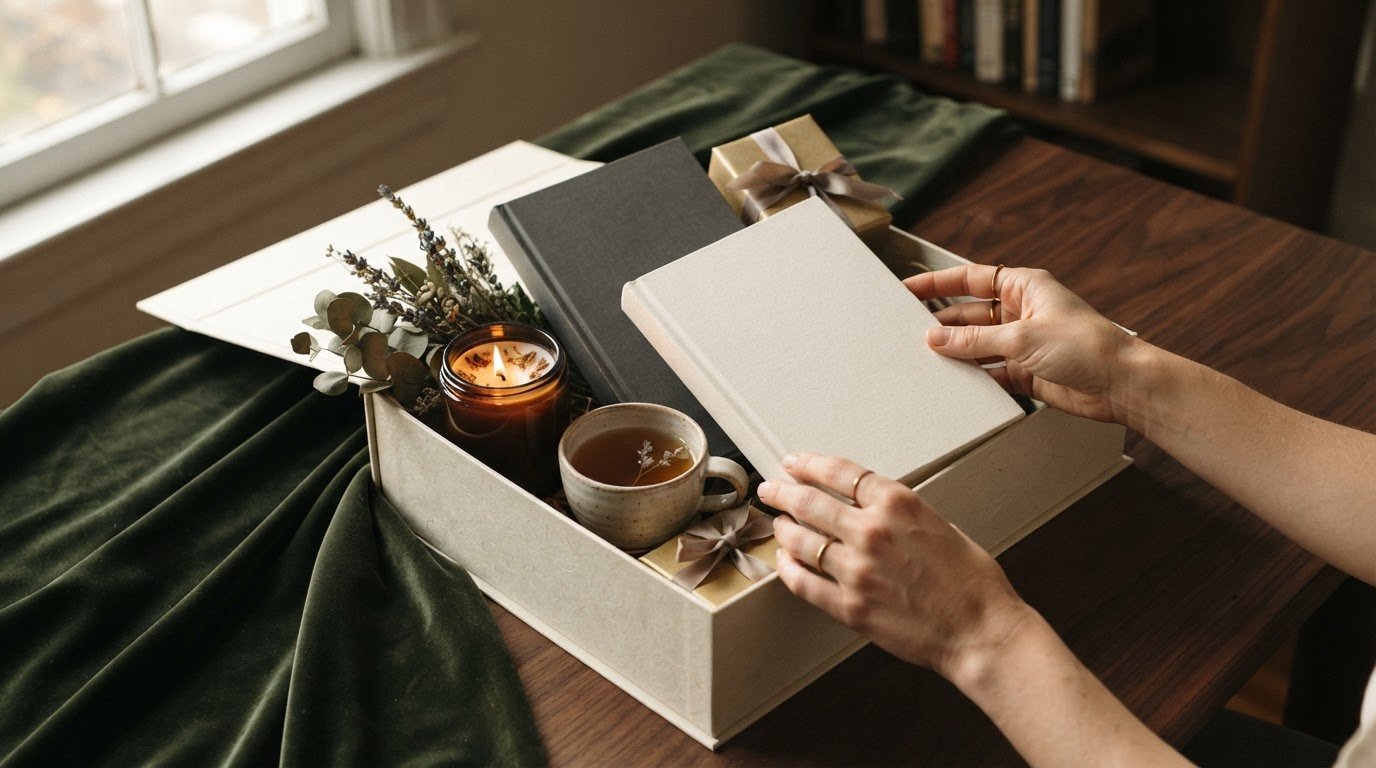
Keep the choice simple. You might begin with one question, one private entry, or a conversation without writing at all. If you’re considering a thoughtful gift connected to reflection, Glimpses Inside also offers curated gift boxes; learn more in this guide to curated gift boxes. They aren’t confirmed as a marriage-journal bundle.
For a quiet next step, explore Glimpses Inside’s reflective publications and check each publication’s contents to see what suits your own reflection. No purchase is needed to begin listening more closely. A small, willing pause can be enough.
Take One Gentle Step Toward Growing Together
A marriage reflection journal can offer a quiet place to notice what you’re feeling and make space to hear one another. Choose a format that feels comfortable for both of you, and keep sharing voluntary. A prompt, a private page, or a thoughtful conversation can all be a beginning.
Keep the practice gentle. You don’t need to fill every page or solve every challenge through writing. The value is in pausing, listening, and returning to reflection when it feels useful. If journaling together doesn’t feel right yet, start on your own or choose another kind of support.
Glimpses Inside is owned and operated by author Ianthe Writes, and its Just 30 Days series offers a relevant starting point for personal reflective writing. Check the publication’s contents and intended use before deciding whether it suits your needs; it isn’t presented as a dedicated couples journal.
If you’d like to explore a reflective publication for your own next step, browse Glimpses Inside’s reflective publications. Begin wherever you are. Small moments of attention can help you keep growing, together or one page at a time.
Frequently Asked Questions
What is a marriage reflection journal?
A marriage reflection journal is a written space for exploring experiences, feelings, needs, and shared life as a couple. It may offer guided prompts, blank pages, or a mix of both. Partners can write privately, respond to the same question, or share selected thoughts aloud. Its purpose is to support reflection and conversation, not to grade the relationship or guarantee change.
Can a marriage reflection journal help couples communicate better?
A marriage reflection journal may give partners a calmer way to gather their thoughts and start a conversation, but it can’t guarantee better communication. For example, each person might write about what helps them feel appreciated, then listen to the other’s answer without rushing to fix anything. The benefit depends on whether both partners feel respected and free to share at their own pace.
How do you use a marriage journal together?
Agree on a prompt and a comfortable amount of time, then decide whether you’ll write separately, speak, or combine both. Each partner can choose what to share, while the listener focuses on understanding rather than rebutting. You can skip a prompt or pause if it feels uncomfortable. Close with a simple appreciation or intention, rather than expecting to resolve every subject that comes up.
What should I write in a marriage reflection journal?
Start with an experience that feels approachable. You could write about a moment you felt supported, a small gesture you appreciated, or something you hope to enjoy together. Other useful subjects include needs that are hard to express and memories that feel meaningful. Keep answers honest but manageable, and remember that writing privately is an option if you’re not ready to share every thought.
What if my spouse does not want to journal?
Respect their hesitation rather than treating journaling as a requirement. Ask whether they’d prefer to talk about one prompt, listen while you reflect, or leave the idea for another time. You can also journal privately without expecting your spouse to read it. The goal is to find a way of reflecting that feels voluntary to both of you, not to persuade one partner to participate.
Is a guided marriage journal better than a blank notebook?
Neither format is automatically better; the right choice depends on how you both like to reflect. Guided prompts offer a starting point when the blank page feels difficult, while an open notebook lets you choose the subject and direction. A mixed format can provide structure with room to wander. If sample prompts are available, look for language that feels welcoming and easy to adapt.
Can couples start journaling if they are going through a difficult time?
Couples can try journaling during a difficult period if both feel willing and able to pause when needed. Begin with a gentle prompt, allow each person to pass, and stop if writing increases distress. A journal is a reflection aid, not therapy or a substitute for qualified support. If conflict or distress feels serious or persistent, consider seeking appropriate outside help rather than relying on journaling alone.