The Daily Self Discovery Journal Checklist: A 30-Day Path to Your Inner Landscape
August 17, 2026 · 17 min read

What if the blank page wasn't a wall to climb, but a soft pillow for your tired thoughts? You've likely sat with a pen in hand, feeling the weight of a day that needs processing but finding no words to meet it. It's common to feel that starting a daily self discovery journal is just another task on an already crowded list. You want depth. You seek connection. Yet, the pressure to be profound often creates a barrier that keeps you from your own heart.
We understand that silence. We know the hesitation that comes when reflection feels like a chore rather than a sanctuary. This guide offers a different rhythm. It's a gentle, 30-day path designed to turn your reflection into a ritual of personal restoration. Through a structured yet soft checklist, you'll find the emotional safety needed to explore your inner landscape. We'll walk through how to transform your writing into a daily ritual that feels like a hug for the spirit, moving from the static of a busy mind toward a lasting sense of clarity and peace.
Key Takeaways
- Learn to shift from simple log-keeping to a deeper state of witnessing your own evolution through intentional reflection.
- Master the three essential elements of a daily self discovery journal to ensure your practice remains both soulful and sustainable.
- Create a sacred physical and emotional space that acts as a gentle invitation for your most honest thoughts; it's a way to feel seen by your own hand.
- Follow a rhythmic 30-day framework designed to guide you through intentional phases of grounding and quiet uncovering.
- Embrace the tactile power of a physical journal as a steady, tangible anchor for your spirit's personal restoration.
The Call to Inner Discovery: Why a Daily Journal Matters
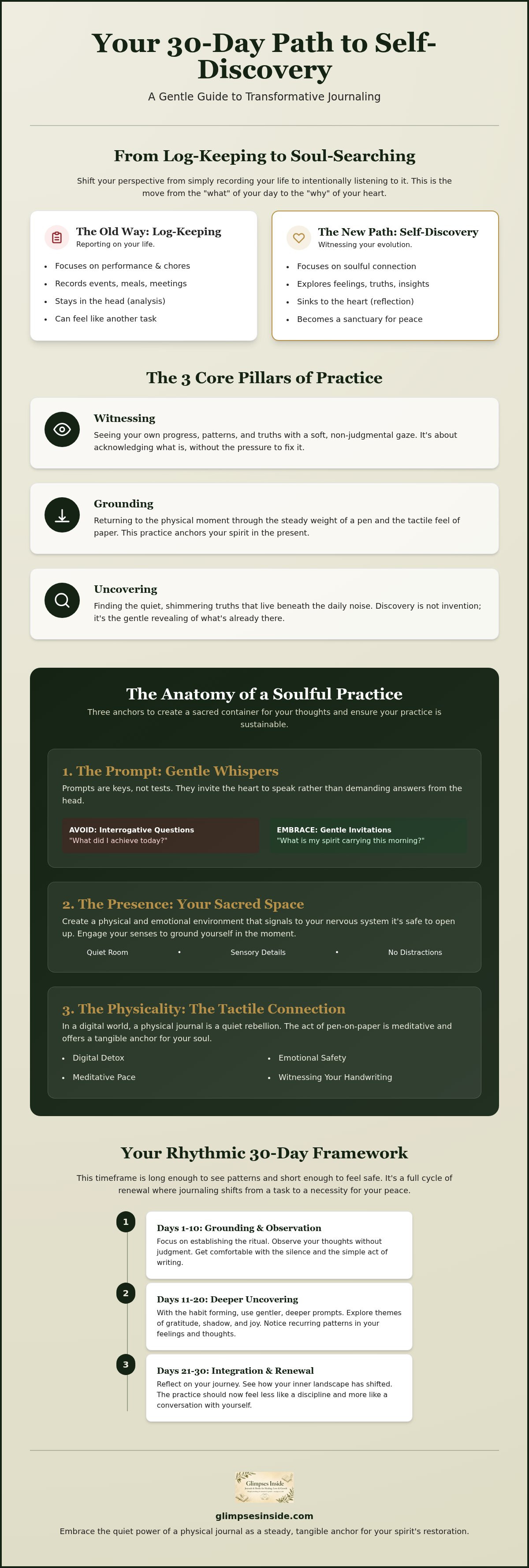
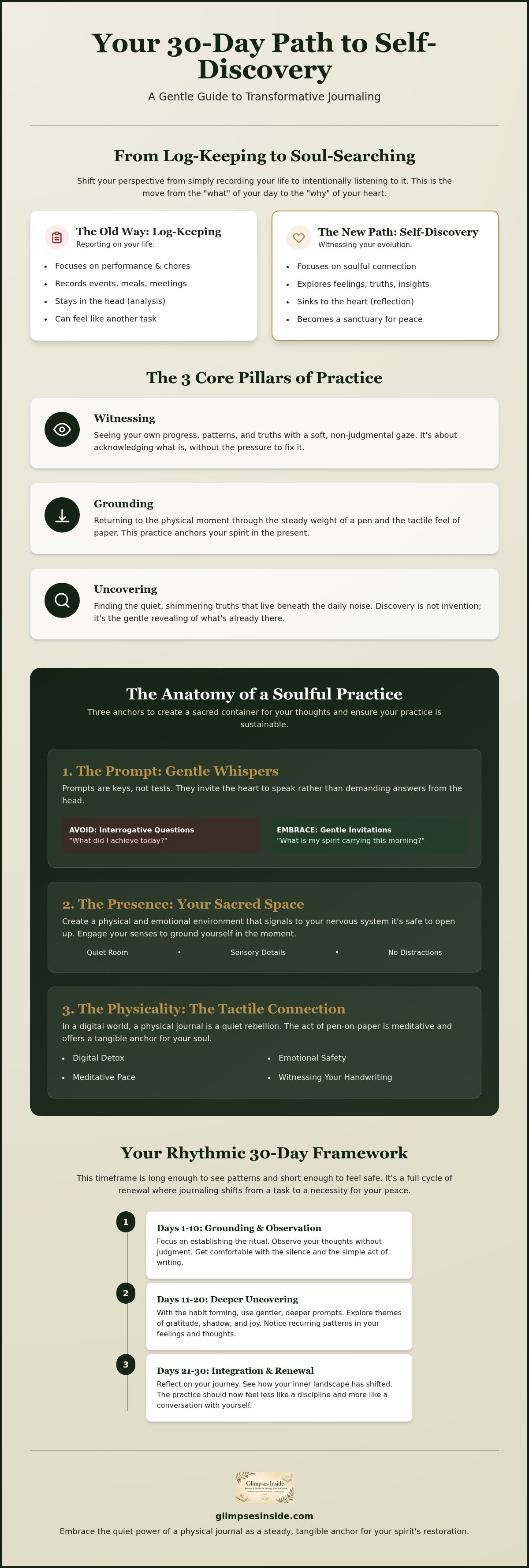
A daily self discovery journal is a sacred witness. It's not a place to perform or a ledger of chores. Instead, it's a dedicated space for witnessing your own evolution, one quiet morning at a time. Most people begin with log-keeping. They record the weather, the meals, and the meetings. But a deeper path exists. The transition from log-keeping to soul-searching happens through intentionality. It's the moment you stop reporting on your life and start listening to it. You move from the "what" of your day to the "why" of your heart.
This practice is about emotional restoration. Your daily words act as a bridge to the heart, connecting the frantic surface of your day to the steady depth of your spirit. If you feel lost right now, or if your life feels too busy for reflection, you're in the right place. That very feeling of being "full" is the perfect starting point. The noise makes the silence more meaningful. You don't need a clear mind to start; you only need a willing hand.
- Witnessing: Seeing your own progress with a soft, non-judgmental gaze.
- Grounding: Returning to the physical moment through the steady weight of the pen.
- Uncovering: Finding the quiet, shimmering truths that live beneath the daily noise.
Beyond the Surface: What Self-Discovery Truly Means
Discovery is not about invention. You aren't trying to create a new persona or fix a broken version of yourself. It's about uncovering what's already there. Surface-level journaling often stays in the head, trapped in analysis and problem-solving. Heart-centered reflection sinks lower. It allows the truth to rise naturally. By using a 30-day container, you provide yourself with a gentle boundary. This timeframe is long enough to see patterns but short enough to feel safe. It's a rhythmic, focused approach to growth that honors your pace.
The Science of the Spirit: How Writing Heals
There's a quiet power in tactile documentation. The simple act of pen-on-paper has a grounding effect that digital tools often lack. It forces a slower, more meditative pace. When you name an emotion, you gain a sense of quiet authority over it. A fear named is a fear understood. Internal rhythms respond to consistency. While three weeks is often cited as the threshold for internal rhythm changes, the full 30-day shift allows for a complete cycle of renewal. It's the point where a daily self discovery journal stops feeling like a task and starts feeling like a necessity for your peace.
The Anatomy of a Soulful Practice: Elements of Discovery
To build a daily self discovery journal practice that lasts, we must look beyond the written words. It's about the architecture of the moment. We call this the anatomy of a soulful practice. It consists of three essential anchors: The Prompt, The Presence, and The Physicality. These elements work in harmony to create a container for your thoughts. Without them, journaling can feel like a chore. With them, it becomes a sanctuary for your evolving self.
The sensory experience is the first step toward depth. Imagine a quiet room. The faint, earthy scent of paper. The rhythmic flow of ink as it meets the page. These small details are not luxuries. They are signals to your nervous system. They whisper that it's safe to open up. When you engage your senses, you ground your spirit in the present. You move away from the frantic pace of the outside world and into the steady pulse of your own heart. This physicality is what makes the practice feel like a tangible anchor for your soul.
The Role of Prompts in Personal Evolution
Prompts are not questions to be answered or puzzles to be solved. They are gentle whispers that invite the heart to speak. Interrogative questions like "What did I achieve today?" often keep us trapped in the head. They focus on performance. In contrast, gentle prompts like "What is my spirit carrying this morning?" allow for a deeper uncovering. By focusing on themes like gratitude, shadow, or joy, you can navigate your inner landscape with more intention. A discovery prompt is a key to a locked room in the spirit. It doesn't force the door open; it simply offers the possibility of entry at your own pace.
The Tactile Connection: Why Physical Journals Matter
In a world of glass screens and constant notifications, the physical journal is a quiet rebellion. It offers a necessary digital detox. The weight and texture of a book provide a sense of emotional safety that a digital app cannot replicate. When you use a physical journal, like those found in the Just 30 Days series, you are making a commitment to your own presence. There is a profound beauty in seeing your own handwriting. It's a form of self-witnessing. Your loops and lines are unique to your pulse. They are evidence of your existence. This tactile documentation anchors your reflection in the physical world, making your internal shifts feel more real and permanent.
Your Sacred Setup: A Pre-Journaling Checklist
Before the pen meets the paper, there is a sacred pause. This is the space where intentionality lives. Setting the stage for your daily self discovery journal is as vital as the writing itself. It signals to your spirit that you're ready to listen. Without this preparation, reflection can feel rushed. With it, every word carries weight. It's the difference between a simple grocery list and a love letter to the soul. By preparing your environment, you create a sanctuary where the messy, unpolished truths of your life are finally welcome.
This ritual is not about perfection; it's about presence. When you curate your space, you're telling yourself that your internal world matters. You are worth the quiet. You are worth the candle. You are worth the thirty minutes of disconnected peace. This intentionality acts as a bridge, moving you from the noise of the outside world to the steady pulse of your own heart.
| Feature | Quick Log Approach | Deep Reflection Approach |
|---|---|---|
| Primary Goal | Record keeping and event tracking | Emotional restoration and discovery |
| Environment | Anywhere, often on the go | Sacred, quiet, and intentional |
| Internal State | Functional and analytical | Vulnerable and present |
| Outcome | A list of daily events | A bridge to the heart and spirit |
Creating an Environment for Emotional Safety
Your surroundings act as an unspoken permission slip. To go deep into your daily self discovery journal, you must feel unobserved and safe. This isn't about luxury; it's about emotional security.
- Choose a quiet corner: Find a space where you won't be interrupted. It could be a specific chair, a spot by a window, or even a cushion on the floor.
- Incorporate sensory anchors: Light a candle with a scent you love. Brew a specific tea. Soften the lighting to signal a shift in focus from the external to the internal.
- Set a digital boundary: Leave your phone in another room. The digital world is loud and demanding; your inner landscape requires a soft, unhurried silence.
Choosing Your Tools: Materials for the Journey
The items you hold are your companions on this path. They should feel like a supportive hand rather than a clinical tool. Choosing materials that resonate with you can elevate the entire experience.
- Select a journal that feels like a companion: The Just 30 Days series is designed to hold your evolution with grace. It acts as a tangible anchor for your spirit.
- Find a pen that glides: Friction between thought and word creates a barrier. Choose a pen that feels effortless on the page, allowing your thoughts to flow without resistance.
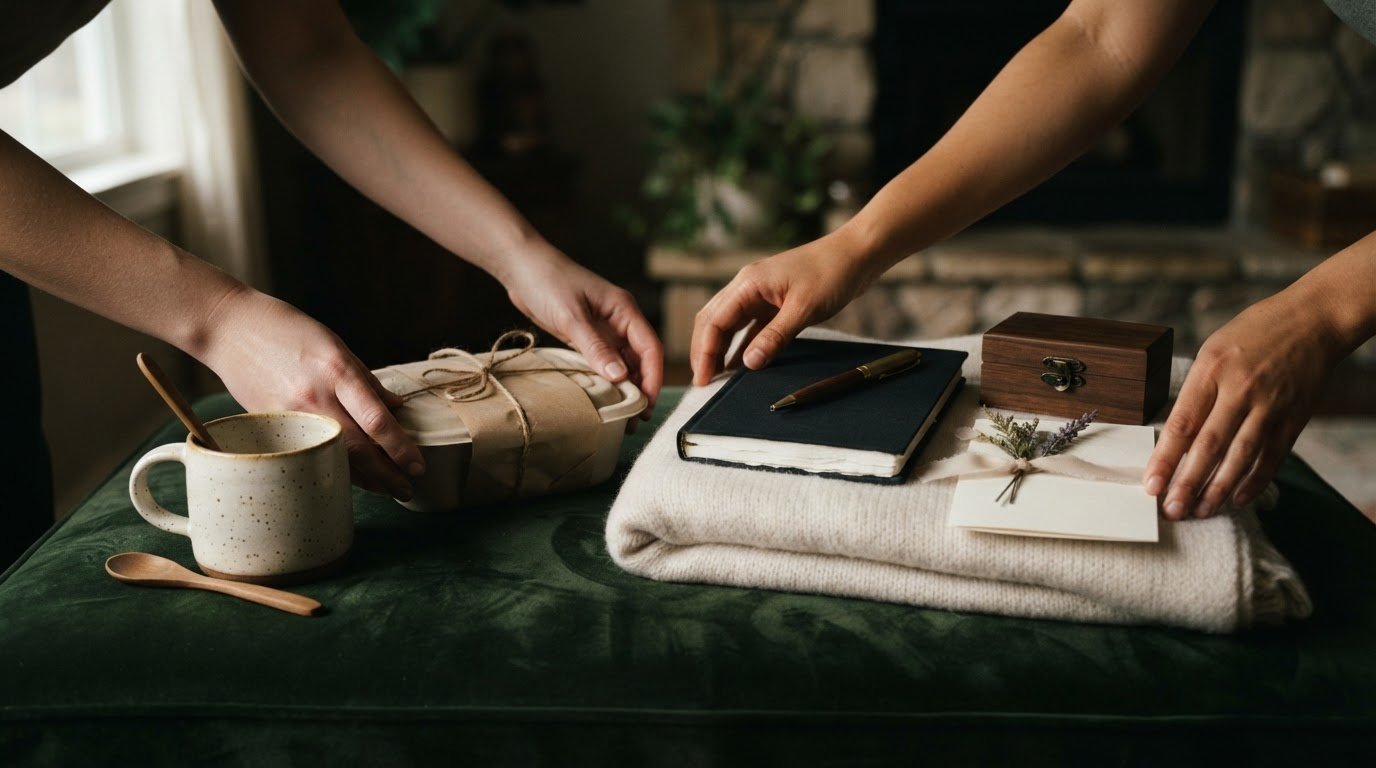
- Consider a curated gift box: Elevate the ritual into a celebration of self. A gift box can provide the tactile elements needed to support a consistent, nurturing practice.
The 30-Day Discovery Checklist: A Rhythmic Guide
A long list of sixty prompts can feel like a mountain to climb. It's too much. It's too loud. Instead, your daily self discovery journal should follow a rhythmic pulse that honors your energy. This 30-day journey is divided into four intentional phases, each lasting one week. Each phase builds upon the last, moving you from the earth beneath your feet to the sky of your potential. This isn't a race to finish. It's a slow walk through your own heart. One breath. One page. One truth at a time.
Before you begin each entry, follow this daily discovery checklist to settle your spirit and prepare for the page:
- Deep breath: Inhale the present, exhale the noise of the day.
- Read the prompt: Let the words sit on your tongue and resonate in your chest.
- Write without editing: Let the ink flow without judgment, shame, or correction.
- Sit in silence: Spend one minute honoring the words you've just shared with the page.
Phase 1 & 2: Grounding and Uncovering
The first fourteen days are about roots. Week one focuses on Awareness. It's the grounding phase where you simply notice your current state. A sample prompt for this time is: "What does my breath want to tell me today?" You aren't looking for deep shifts yet. You're just arriving. Week two shifts into Exploration. This is the uncovering. You begin to look at the corners you usually avoid. Ask yourself: "Which parts of me have I been keeping in the shadows?" It’s a brave act of witnessing that requires a steady, gentle hand.
Phase 3 & 4: Healing and Becoming
Week three is for Restoration. After the uncovering of the previous week, your spirit needs a gentle hand. Use restoration prompts that offer comfort and quiet. A vital checklist item for this phase is to review your previous entries. Look for the threads of your own story. What themes keep appearing? Finally, week four is about Evolution. This is the becoming. You aren't the same person who started on day one. Reflect on your growth with a prompt like: "Who is the woman I am evolving into, and what does she need?" This final week is a celebration of your internal landscape.
To support this rhythmic progression and find a space that holds your evolution with grace, explore the Just 30 Days series for your next chapter of reflection.
Continuing the Journey with Glimpses Inside
The journey of self-reflection doesn't reach a final destination on day thirty. Instead, it opens a door to a lifelong conversation with your spirit. At Glimpses Inside, we believe that the written word is a tool for profound internal shifts. The "Just 30 Days" series is the logical next step for your daily self discovery journal. These publications are crafted with a specific kind of intentionality. Ianthe Writes brings a unique, nurturing voice to every page, ensuring that your path to self-awareness feels supported and safe. It's about moving away from high-energy demands and toward a soft-spoken confidence.
Your journal is not merely a book of paper and ink. It's a "glimpse inside" the very core of who you are. It's a place where your evolution is documented with grace and kindness. When you view your practice through this lens, the pressure to be perfect fades away. What remains is a steady, non-judgmental witness to your own life. Every entry is a step toward restoration. Every word is a piece of your story finally coming home to itself.
The Just 30 Days Series: Your Gentle Guide
The "blank page" anxiety is a common barrier to consistent reflection. It feels like a wall. It feels like a demand for profound insights that may not be ready to surface. The "Just 30 Days" series acts as a supportive whisper for your discovery path. By providing curated prompts, these journals remove the fear of the unknown. They offer a rhythmic, unhurried flow that honors your natural pace. You don't need to invent a persona. You only need to respond to the gentle invitations found within the pages. It's a structure that lets your ideas breathe, mirroring the reflective nature of the spirit itself.
Curated Gifts for the Reflective Soul
A soulful practice is often enhanced by the environment in which it lives. Our curated gift boxes are designed to support your "Sacred Setup Checklist" with tactile beauty. Each box is a collection of intentionality. They serve as a hug for the spirit, especially during hard or deeply reflective seasons of life. These boxes turn the act of documenting your life into a celebration of self-care. They provide the sensory anchors needed to ground your spirit before the pen even touches the page. We invite you to explore the full collection of books and boxes at glimpsesinside.com. Here, you'll find the tools to turn your daily self discovery journal into a lasting ritual of personal restoration and quiet hope.
Embrace the Rhythm of Your Own Evolution
Your inner landscape is a place of quiet beauty, waiting to be witnessed. You've discovered that a daily self discovery journal isn't a task to complete; it's a sanctuary for your spirit. By honoring the sacred setup of your space and following a rhythmic path of grounding and uncovering, you've built a bridge to your own heart. This practice is about the steady, incremental progress of finding yourself in the silence. It's about personal restoration. One breath. One page. One truth.
You don't have to walk this path alone. The "Just 30 Days" series by Ianthe Writes offers a supportive whisper to guide your evolution. Together with our thoughtfully curated gift boxes, these journals provide a tangible anchor for your spirit. Our brand is built on emotional safety and the belief that small, consistent actions lead to profound internal shifts. Every page is an invitation to be seen by your own hand. Every word is a step toward home.
Begin your 30-day journey of discovery with our curated journals. Your story is unfolding with every word. Trust the unhurried process, honor your unique pace, and remember that your evolution is a beautiful, unfolding work of art.
Frequently Asked Questions
What is a daily self discovery journal?
It's a dedicated space for witnessing your evolution through intentional prompts. Unlike a simple log of events, it focuses on the internal landscape of your heart. It acts as a tangible anchor for the spirit during times of change. It's a rhythmic practice of turning inward to find clarity and peace. This ritual helps you move from the surface of life to the depth of your soul. It's a gentle invitation to see yourself clearly.
How long should I journal for self-discovery each day?
You only need fifteen to twenty minutes of quiet presence to see a shift in your perspective. It's not about the quantity of words, but the quality of your attention. Some days might require only ten minutes of grounding. Other days, the ink might flow for longer as you uncover hidden truths. The key is consistency rather than duration. A short, daily ritual is more restorative than a long, sporadic session that feels like a chore.
Do I need to be a good writer to start a self-discovery journal?
You don't need any writing experience to begin this journey. This isn't a performance or a graded assignment. Your daily self discovery journal is a private conversation between you and your heart. Forget about grammar, spelling, or perfect prose. The goal is honesty, not eloquence. Your spirit doesn't care about sentence structure; it only seeks to be heard and understood in its most raw and unpolished form. Let the pen move freely.
What happens if I miss a day in my 30-day journey?
Simply return to the page when you're ready with a spirit of self-compassion. Missing a day isn't a failure; it's a natural part of any unfolding process. There's no need to "catch up" or feel guilty about the gap. Pick up exactly where you left off in the checklist. The 30-day container is a guide, not a rigid law. Every time you return to your journal, you're choosing yourself and your healing all over again.
Can journaling really help with emotional restoration?
Writing provides a way to name your emotions, which offers a sense of quiet authority over them. By documenting your internal shifts, you create a path toward healing. It's a proactive tool for mental fitness that regulates the nervous system. The tactile act of putting pen to paper grounds you in the physical moment. Over time, this daily ritual acts like a hug for the spirit, fostering a lasting sense of peace and internal safety.
What is the difference between a diary and a self-discovery journal?
A diary typically records external events, while a daily self discovery journal explores your internal response to those events. Diaries are often retrospective logs of what happened. Discovery journals are prospective journeys into who you're becoming. They use intentional prompts to dig beneath the surface of daily life. While a diary captures the "what," this practice focuses on the "why" and the "how" of your evolving spirit. It's about depth, not just documentation.
Should I re-read my journal entries?
Re-reading your entries can be a powerful way to see the threads of your own story. We recommend waiting until the end of each thematic week to look back. This allows you to notice patterns or shifts in your emotional state without judgment. Seeing your own growth in your own handwriting is a profound form of self-witnessing. It confirms that you are moving forward, even on days when the progress feels slow or invisible.
How do I know if my journaling practice is "working"?
You'll notice a shift when the "blank page" no longer feels like a chore, but a soft invitation. Progress often looks like a sense of quiet clarity during your day. You might find yourself more present in your relationships or more compassionate toward your own struggles. It's not about big, dramatic changes. It's about the small, rhythmic pulses of peace that begin to settle into your daily life and your spirit over time.