Daily Reflection: A Guide to Emotional Restoration
August 8, 2026 · 17 min read

What if the quietest part of your day became the most powerful? Life moves with a relentless speed. It leaves us breathless. It leaves us feeling like we're watching our own lives from the sidelines. You're likely tired of the noise and the emotional fog that makes it so hard to name what you're truly feeling. Learning how to practice daily reflection is the first step toward clearing that fog. You want to feel whole again. You want to feel seen, even if it's only by yourself.
It's not about adding another task to your list. It's about creating a sanctuary. We'll show you how to turn a simple habit into a restorative ritual that heals the heart and deepens self-awareness. We'll explore how the "Just 30 Days" series acts as a gentle companion for this journey. You'll discover the tactile power of documentation and the small, consistent steps that lead to profound inner peace. By the end, you'll have a clear path to feeling restored rather than drained.
Key Takeaways
- Learn to distinguish between the chaos of random thoughts and the intentional stillness of a quiet internal conversation.
- Discover how to practice daily reflection by establishing a sanctuary space and beginning with one gentle, heart-centered question.
- Reclaim your focus through the tactile experience of a physical journal, allowing the flow of ink to ground your wandering spirit.
- Transform your daily rhythm from a series of reactive moments into a deliberate ritual of emotional safety and self-discovery.
- Move beyond the pressure of perfection by focusing on being present, using tools like the "Just 30 Days" series for incremental progress.
Understanding Daily Reflection: An Invitation to Stillness
Imagine your inner life as a landscape. Most days, we rush through it. We ignore the trees. We miss the quiet streams. Daily reflection isn't a performance or a metric for success. It's a quiet conversation with that landscape. It's an invitation to sit still and listen. Many people confuse thinking with reflecting. Thinking is often chaotic; a whirlpool of worries and to-do lists. Reflection is different. It is intentional. It is a choice to turn your gaze inward. With purpose.
You might think that learning how to practice daily reflection requires hours of solitude in a remote cabin. This is a common misconception that keeps many from starting. In reality, restoration happens in the small spaces. It lives in the cracks of a busy schedule. We call these "Glimpses Inside." They are brief moments of clarity. A single deep breath. A sentence written in a journal. These small acts are the seeds of emotional restoration. They don't require perfection; they only require your presence.
Why Our Hearts Crave the Pause
We often live on autopilot. We move from one task to the next without feeling the weight of our own feet. This constant motion creates a subtle numbness. We stop feeling the nuances of our joy. We lose touch with the source of our exhaustion. The pause is the bridge. It's the path back to who you are beneath the roles you play. When you stop, you begin to come home to your own thoughts. It feels like stepping into a warm room after a long walk in the cold. It's sensory. It's grounding. It's necessary.
The Difference Between Self-Awareness and Self-Judgment
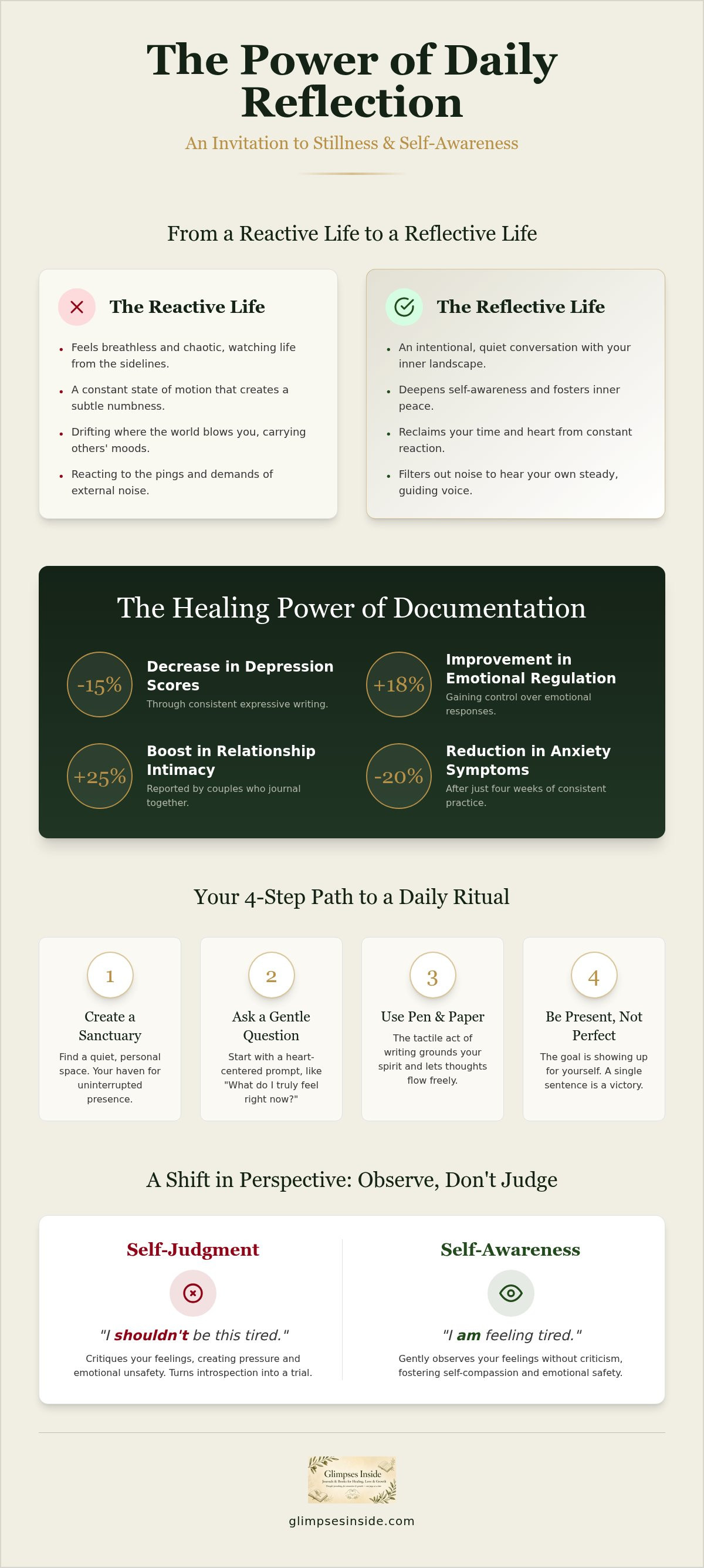
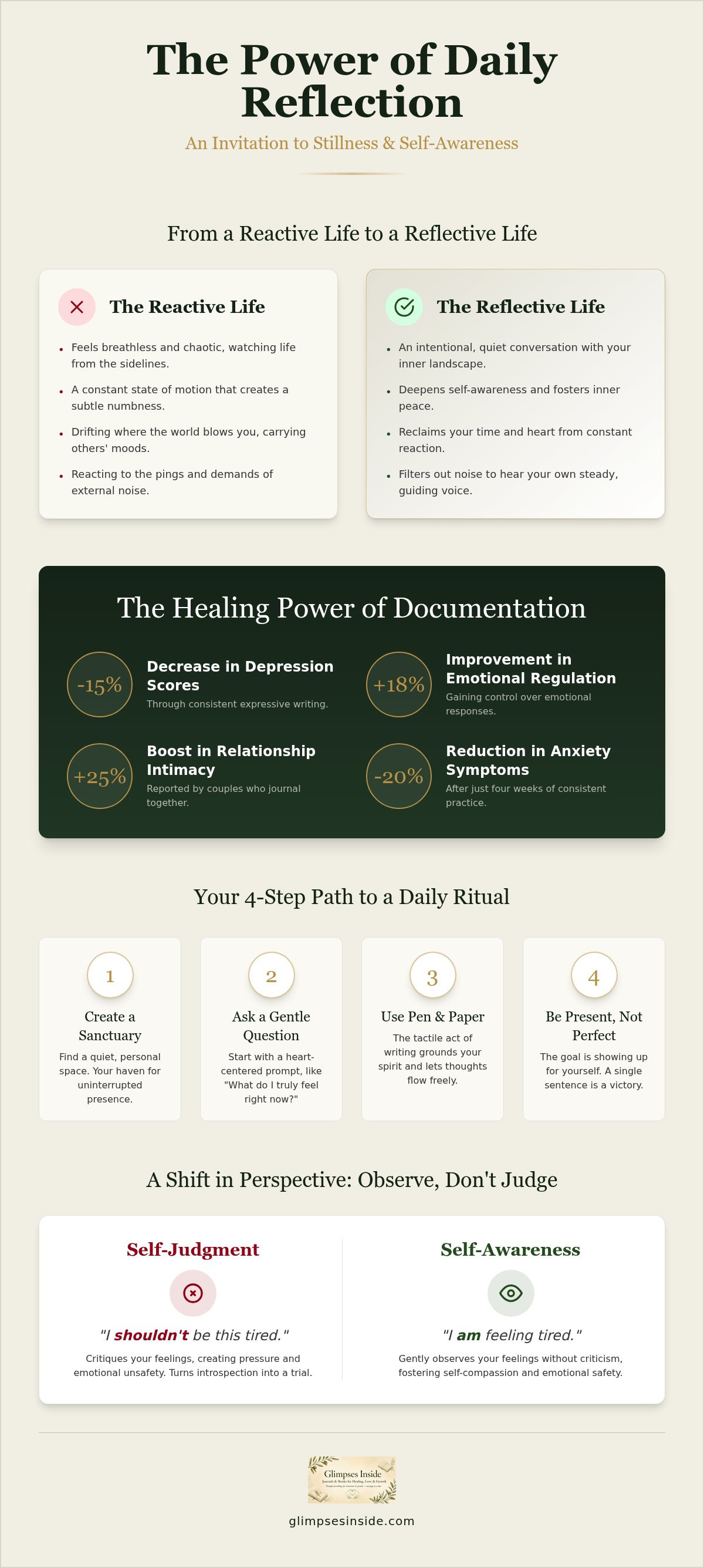
There is a delicate line between looking at yourself and picking yourself apart. The practice of introspection should never feel like a trial. It is not an interrogation. True reflection is about observing your feelings without the need to critique them. Think of it as a gentle observation. You are a witness to your own heart. When you learn how to practice daily reflection, you learn to say, "I am feeling tired," instead of, "I shouldn't be this tired." This shift creates emotional safety. It allows your spirit to breathe. It turns the act of looking inward from a chore into a supportive whisper that guides you toward peace.
The Benefits of a Reflective Life: Beyond the To-Do List
Living reactively is like being a leaf in the wind. You drift where the world blows you. You react to the ping of a phone. You carry the weight of a stranger's mood. Reflection changes the current. It moves us from a state of constant reaction to a place of deep intention. When you learn how to practice daily reflection, you begin to reclaim your time. You begin to reclaim your heart.
The world is loud. It demands your attention without pause. Daily stillness acts as a filter. It allows the noise of external expectations to fade into the background. You start to hear your own voice again. It is a soft-spoken voice. It is a steady guide. It is the part of you that knows exactly what you need to feel whole.
This practice is a vessel for healing. It is a tool for evolution. Research indicates that expressive writing can decrease depression scores by 15% and improve emotional regulation by 18% according to industry studies. These are not just statistics. They represent a softening of the spirit. They represent a heart that is learning to mend its own quiet fractures. It is a way to move through the world with a sense of steady, internal grace.
True intimacy begins within. We cannot connect deeply with others if we are strangers to our own internal landscape. Reflection fosters this connection. In fact, couples journaling can boost intimacy by 25%. By understanding your own needs, you become more present for those you love. You become a steady hand for others because you have learned to hold your own.
Finding Lasting Peace in Incremental Shifts
Transformation does not require a thunderclap. It requires a pulse. Committing to a consistent rhythm can significantly rewire your emotional responses. Industry data shows that journaling can reduce anxiety symptoms by 20% after just four weeks of practice. This is the power of small, daily documentation. Personal restoration is the quiet, cumulative result of these stolen moments of stillness. If you're seeking a gentle way to start, the Just 30 Days series provides a nurturing structure for this unfolding journey.
Restoring the Spirit Through Narrative
Every time you put pen to paper, you are reclaiming your story. You are no longer a character in someone else's narrative. You are the author. This agency is vital for personal evolution. There is a profound wisdom found only in silence. It teaches us what we truly need versus what we have been told to want. The work of Ianthe Writes explores these themes of healing and the quiet power of the heart. It reminds us that our stories are worth documenting. They are worth the time it takes to listen. They are the maps of our restoration.
The Sensory Journey: Why the Heart Prefers Paper
The scent of a fresh page. The weight of a pen in your hand. The quiet scratch of nib against paper. These are the textures of a life slowed down. Digital apps promise convenience. They offer speed. But speed is often the very thing we're trying to escape. When you explore how to practice daily reflection, you'll find that the heart often prefers the slower pace of a physical page. It's a tactile return to the self. It's a way to ground your spirit in the here and now.
There's a biological magic in the hand-to-brain connection. Research indicates that writing by hand engages the brain more deeply than typing. It forces a deliberate pause. You cannot delete a difficult thought with a flick of a thumb. You must sit with it. You must let the ink dry. This slowing down is where the real restoration begins. It's the difference between a fleeting notification and a lasting realization.
A physical journal becomes a tangible legacy. It's a map of your inner voyage. Years from now, you won't scroll through an old app to find your soul. You'll reach for a book. You'll touch the pages where your hand once rested. You'll see the slight tremor in your handwriting during a hard season. You'll see the bold, confident strokes of a day filled with joy. It's a bridge across time. It's a testament to the fact that you were here. That you felt. That you grew.
Digital Noise vs. Analog Stillness
Screens come with baggage. Blue light acts as a barrier to deep emotional entry. It signals the brain to stay alert. To stay reactive. A phone is a gateway to the world's demands. It's a source of pings and pressures. A journal is a gateway only to yourself. There's no "undo" button in a physical notebook. This permanence is a gift. It teaches us to accept our messy, unpolished truths. It creates a sacred space that a digital device simply cannot replicate. It allows you to be vulnerable without the fear of a notification interrupting your peace.
The Beauty of the Tangible
The ritual starts before the first word is written. It begins when you pick up the book. This simple movement signals your brain to relax. To breathe. The "Just 30 Days" series is designed to be a vessel for these physical reflections. These journals are more than paper; they are homes for your evolving spirit. Aesthetic beauty matters in tools for self-discovery. When a journal feels special, the act of reflection feels like a gift rather than a chore. It honors the importance of your journey. It makes the practice of how to practice daily reflection something you look forward to at the end of a long day.
How to Practice Daily Reflection: A 30-Day Ritual
Restoration isn't an accident. It's a ritual. To understand how to practice daily reflection, you must first build a home for your thoughts. This isn't about productivity. It's about presence. We invite you into a 30-day journey of quiet discovery. This timeframe is intentional. It gives the heart enough space to learn a new language. It's a season of growth.
- Step 1: Create a Sanctuary Space. Find a spot that feels like yours. A chair by the window. A corner with a soft pillow. Consistency signals safety to the heart.
- Step 2: Set the Intention. Don't face the page with a heavy spirit. Start with one gentle question. "What does my soul need to say today?"
- Step 3: The Act of Documentation. Let the ink flow. Forget the rules of grammar. Ignore the pressure of perfection. This is a release, not a report.
- Step 4: The Closing Breath. When you finish, don't rush away. Close your eyes. Take one deep, intentional breath. Feel the weight lift.
- Step 5: The 30-Day Commitment. Give yourself the grace of time. Small, consistent actions lead to the most profound internal shifts.
This structure helps you move from autopilot to intentional stillness. It turns a chaotic mind into a calm landscape. If you're ready to begin this journey with a physical companion, you can explore the Just 30 Days series to find a journal that speaks to your spirit.
Morning Stillness vs. Evening Review
The time you choose matters less than the heart you bring to it. Morning reflection sets a soft tone for the day ahead. It's a way to gather your light before the world demands it. Evening review is different. It's a way to release the day's weight. It's a way to lay down the burdens you've carried. Choose the rhythm that fits your busy heart. Remember, the sacred pause is a non-negotiable act of self-love. It's your time to breathe.
Gentle Prompts for the Unfolding Soul
Sometimes the hardest part is the first word. Small talk with yourself is the first step toward deep intimacy. It builds a bridge to the parts of you that have been ignored. You don't need to be profound. You only need to be honest. Try these soft prompts to guide your pen when you're learning how to practice daily reflection:
- What made my heart feel light today?
- Where did I feel a small nudge of growth?
- What is one thing I can forgive myself for tonight?
As you write, follow a simple pattern. Look for the light, look for the lesson, look for the path. This focus ensures your reflection remains a tool for restoration rather than a list of grievances. It's a way to see your own evolution clearly. It's a way to honor the beauty of your unfolding process.
Your Path Forward: Restoration Through Documentation
The journey from autopilot to intentional stillness is a path of returning. You have seen how the noise of the world can drown out your inner landscape. You have explored the power of the tactile page. Now, the path forward is yours to walk. Remember that the goal was never to be perfect. Perfection is a wall. Presence is a door. When you consider how to practice daily reflection, let it be a soft landing. It is a place where you are allowed to be unfinished. It's a space where your spirit can finally breathe without the pressure to perform.
Your journal is more than a book. It is a supportive companion that holds your secrets without judgment. It witnesses your growth. It honors your silence. You don't need a grand plan to begin. You only need five minutes. Start tonight. Start with a single sentence about the light you found today. The cumulative power of these small, quiet moments is what creates lasting restoration. It is the steady, calm pulse of a life lived with intention.
The 'Just 30 Days' Companion
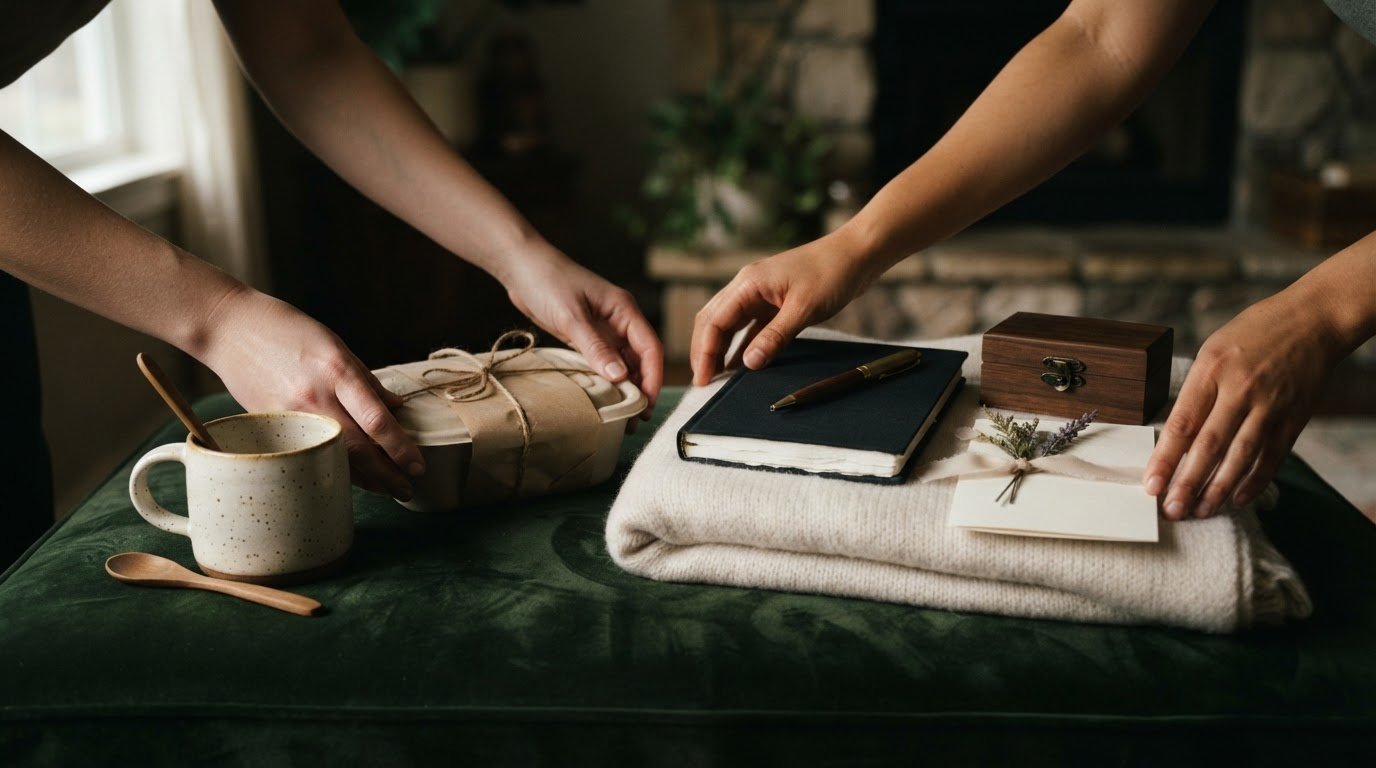
Finding the right structure can make all the difference when you are learning how to practice daily reflection. The 'Just 30 Days' series was created to be a gentle guide for this exact ritual. These journals provide the scaffolding for emotional safety. They take the guesswork out of the process, allowing you to focus on the feeling of the pen and the truth of your thoughts. For those who want to deepen the sensory experience, our curated gift boxes offer a way to engage the heart and the senses simultaneously. They turn a simple habit into a sacred event that honors your personal evolution.
Entering the World of Ianthe Writes
This journey doesn't have to be solitary. You are part of a community of thoughtful observers who value depth over speed. We are all learning to listen to the quiet wisdom of our own lives. Upcoming books by Ianthe Writes will continue to explore the nuances of human connection and the beauty of the unfolding soul. These works are written for the spirit that seeks to understand itself more deeply. They act as a steady hand for those seeking to maintain meaningful bonds with themselves and others.
The first step is always the most courageous. Take it now. Begin your 30-day journey of restoration and see how the simple act of documentation can heal the heart. Your future self is waiting to be met on the page.
Embracing the Quiet Path to Yourself
Your inner landscape is waiting for you to return. You've discovered that stillness isn't empty; it's full of the answers you've been seeking. By choosing paper over screens, you create a sanctuary for your most vulnerable thoughts. You move from a state of reaction to a state of deep, intentional grace. Learning how to practice daily reflection is a gift you give to your future self. It's a commitment to your own personal restoration.
Transformation happens in the small, consistent moments. It lives in the scratch of a pen and the quiet of a morning. Thoughtfully designed by author Ianthe Writes, our journals offer a screen-free space to document your unfolding story. These physical tools focus on incremental progress over 30 days, ensuring you feel held and understood throughout the process.
Discover the 'Just 30 Days' Series for Your Inner Voyage
The path is open. The pages are ready. Trust the beauty of your own unfolding process. You are worth the time it takes to listen.
Common Questions About the Path to Restoration
What if I miss a day of my daily reflection practice?
Missing a day is simply an invitation to practice self-compassion. Your journal is a patient companion that doesn't keep score. If life gets in the way, don't let guilt build a wall between you and your inner world. Simply pick up your pen when you're ready again. The goal of learning how to practice daily reflection is to find restoration, and guilt is the opposite of that peace.
How long should a daily reflection session take for a beginner?
Start with just five to ten minutes of quiet focus. You don't need hours of solitude to find clarity. Research suggests that even brief sessions of expressive writing can improve emotional regulation by 18%. Begin with a single page or a few sentences. Let the rhythm of your own heart dictate the pace. It's about the quality of your presence, not the quantity of your time.
Do I need to be a 'good writer' to practice reflection?
You don't need to be a "good writer" because this documentation is for your soul alone. Grammar and spelling have no place in your sanctuary space. This is not a performance; it's a release. Your handwriting might be messy or your thoughts might be fragmented. That's okay. The value lies in the act of discovery, not in the polish of the prose.
What is the best time of day for self-reflection?
The best time is the moment you can most easily find stillness. For some, morning reflection gathered before the world wakes sets a soft tone for the day. For others, an evening review helps release the day's weight before sleep. Listen to your own internal clock. Choose the hour that feels like a gift rather than an obligation.
How can I reflect if I feel like nothing significant happened today?
Reflect on the small, quiet details of your internal landscape even when the day feels ordinary. Significance isn't found only in big events. It's found in the smell of your coffee, the way the light hit a leaf, or a fleeting thought of a friend. When you're learning how to practice daily reflection, you learn that every day holds "Glimpses Inside" worth documenting.
Is it better to use prompts or just write freely?
Use prompts when you feel stuck and free writing when your thoughts are already flowing. Prompts act as a gentle nudge when the blank page feels intimidating. Free writing allows for an unhurried stream of consciousness. Many find that the "Just 30 Days" series provides the perfect balance of structure and space. Experiment with both to see what helps your spirit breathe.
Can daily reflection help with relationship issues or loneliness?
Daily reflection can significantly improve your connections with others by first deepening your connection with yourself. Studies show that couples journaling can boost intimacy by 25%. By understanding your own needs and naming your feelings, you become more present in your relationships. It eases loneliness by reminding you that you are a supportive companion to yourself.
What should I do if my reflections make me feel sad or overwhelmed?
Close your journal and take a deep, grounding breath if your reflections feel too heavy. Emotional safety is the priority. You don't have to solve every feeling in one sitting. Acknowledge the sadness, then step away. Restoration is a gradual process. If the internal landscape feels too stormy, wait for a calmer moment to return to the page.